

Have you ever received a message that simply says SMFH and wondered what it means? This popular internet abbreviation appears in text messages, social media comments, and group chats. SMFH stands for Shaking My F*cking Head. People use it to express strong frustration, disbelief, disappointment, or annoyance. It is more intense than the familiar abbreviation SMH. You might see it when someone makes a silly mistake or shares something hard to believe.
Understanding smfh meaning makes online conversations easier to follow. The expression can sound serious, sarcastic, or playful, depending on the situation. Friends may use it to tease each other, while others use it to show genuine disappointment. However, SMFH contains profanity, so it isn’t suitable for every setting. This guide explains its common uses, real-life examples, related slang, and natural ways to respond.
Origin and Cultural Footprints of SMFH
The smfh meaning comes from the physical act of shaking your head when something feels ridiculous or disappointing. People have used this head-shake gesture for generations. It works as a form of nonverbal communication that shows disbelief, frustration, or disapproval without saying anything.
As texting became popular, internet users shortened this expression to SMH (Shaking My Head). Later, people added an extra letter to create SMFH (Shaking My F*cking Head). This intensified acronym expresses stronger emotions.
Here are some important points about its development:
- Early social media: SMH and SMFH spread through online forums and comment sections.
- Early 2010s: The abbreviation gained visibility through Twitter/X and group texting.
- Meme culture: Users adopted SMFH to react to ridiculous situations and funny mistakes.
- Modern usage: Gen Z and Millennials use it in DMs, captions, and group chats.
Today, SMFH remains a familiar texting slang expression for strong disbelief and annoyance.
Other Meanings of SMFH
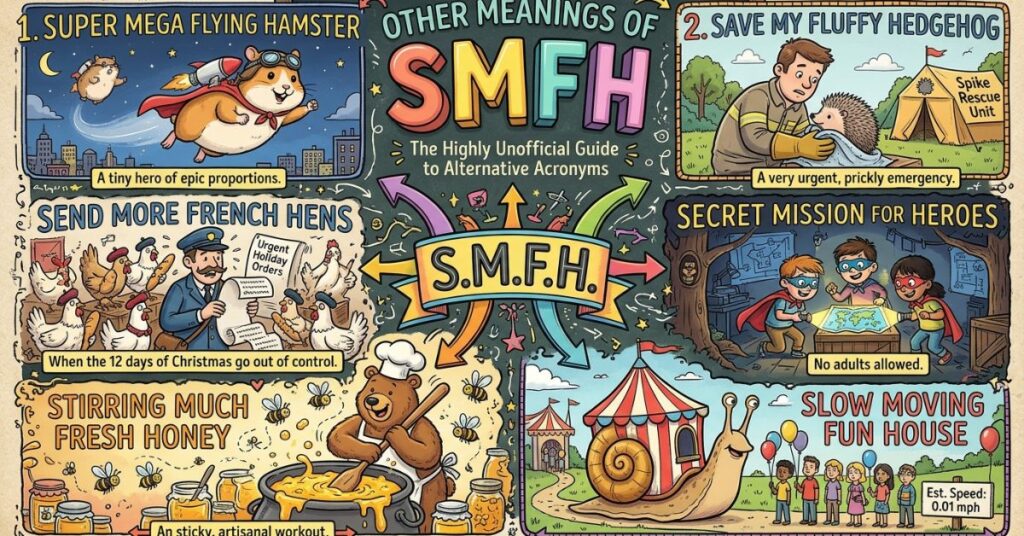
The most common smfh meaning is Shaking My F*cking Head. People use it when something seems frustrating, unbelievable, or completely disappointing. However, some users confuse it with other abbreviations because their letters look similar.
Here are a few meanings and variations worth understanding:
- Shaking My F*cking Head: The standard meaning, used to express strong frustration or disbelief.
- Shaking My Motherf*cking Head: A more explicit variation that adds extra emotional intensity.
- SMMFH: Sometimes used as shorthand for Shaking My Motherf*cking Head.
- So Much for Hope: A rare suggested interpretation, but not an established common meaning.
- SMH: Shaking My Head, a milder expression of disappointment or disapproval.
You might also encounter SMTH, which usually means something, and SM, which often means so much.
Example:
- Friend: We missed the concert because I forgot the tickets.
- You: SMFH, we planned this for weeks!
Always check the surrounding message before assuming an abbreviation’s meaning.
Why Does SMFH Have So Many Different Definitions?
Internet slang changes quickly. People often create new abbreviations, adjust existing phrases, and develop inside jokes within online communities. That’s why the same letters sometimes carry different meanings across conversations.
However, SMFH has one widely recognized definition: Shaking My F*cking Head. Its emotional meaning can change depending on the situation.
For example, someone might use it to express:
- Frustration: When something goes completely wrong.
- Disbelief: When someone shares unbelievable news.
- Disgust: When a person witnesses unacceptable behavior.
- Secondhand embarrassment: When someone makes an awkward mistake.
- Sarcasm: When a situation seems too ridiculous to take seriously.
The abbreviation also works as an emotional intensifier. Unlike SMH, SMFH adds stronger language to the same head-shaking reaction.
Example:
- SMH: You forgot your homework again.
- SMFH: You forgot your entire backpack again?
Both express disapproval, but the second carries greater emotional intensity.
Does SMFH Mean the Same Thing Outside the US?
Yes, SMFH generally carries the same meaning across different English-speaking countries. American, British, and Australian texters commonly use it to express frustration, disbelief, or disappointment.
The main difference comes from local texting habits and everyday expressions. People may choose different words to communicate the same reaction.
For example:
- American texters: Often use SMFH when reacting to ridiculous situations or frustrating news.
- British texters: May combine SMH with casual expressions like mate.
- Australian texters: May use similar shorthand alongside relaxed local slang.
- Online communities: Often adopt SMFH without changing its original meaning.
Consider this example:
Friend: I waited two hours, and the shop closed before I arrived.
Reply: SMFH mate, that’s seriously unlucky!
The phrase works because the meaning comes from shared internet slang rather than a specific country’s culture.
Still, context matters. Some people outside the US might recognize SMH more quickly than its stronger variation.
Who Uses It Most?
SMFH appears in conversations across different age groups and online communities. Gen Z and Millennials often recognize this texting abbreviation because they grew up with internet slang and digital communication.
However, its use isn’t limited to younger people. Anyone familiar with texting shorthand can understand and use it.
Here are some common groups that use SMFH:
- Gen Z: Uses it in TikTok comments, Instagram DMs, and group chats.
- Millennials: Often use it when discussing frustrating experiences with friends.
- Sports fans: Type SMFH after missed goals, bad plays, or unexpected losses.
- Coworkers: Sometimes use it privately in Slack DMs when discussing workplace problems.
- Close friends: Use it for playful exaggeration, sarcasm, and everyday complaints.
Example:
Friend: Our team missed another open goal!
You: SMFH, how does that even happen?
The abbreviation can also appear when a girl says SMH during a conversation. However, her exact feelings depend on context and tone. She might feel annoyed, disappointed, or simply amused.
Real Conversation Examples Using SMFH
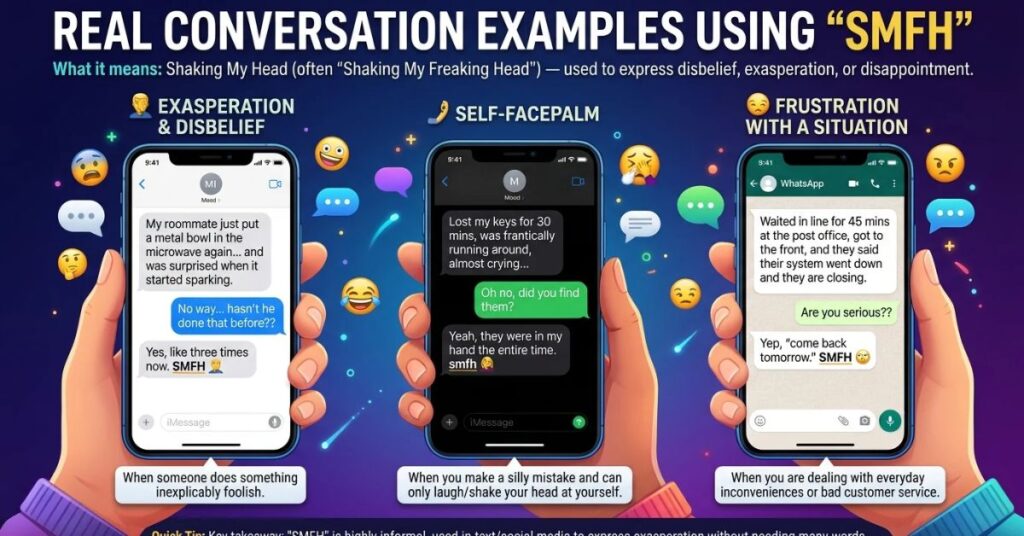
The easiest way to understand the smfh meaning is through everyday conversations. People use it when something feels ridiculous, frustrating, or difficult to believe.
Here are some realistic examples showing how it works in different situations.
Example 1: Job application rejection
- Alex: They rejected my application because of one missing comma.
- Jake: SMFH, you worked so hard on that application.
This response shows disbelief and sympathy toward a disappointing situation.
Example 2: Sports blunder
- Mike: He missed an open goal from two feet away.
- Ryan: SMFH, that was an easy chance!
Here, SMFH expresses frustration about a terrible sports mistake.
Example 3: Funny group chat moment
- Emma: My brother walked into a glass door again.
- Lily: SMFH 😂 How does he keep doing that?
The abbreviation expresses playful embarrassment rather than serious anger.
Example 4: Workplace frustration
- Sam: The manager changed the deadline for the third time.
- Chris: SMFH, we can’t keep working like this.
This conversation shows annoyance about an ongoing workplace problem.
Example 5: Cringe video reaction
- Mia: Did you see that awkward dance video?
- Ava: SMFH, I couldn’t even finish watching it.
Here, the expression communicates secondhand embarrassment and humor.
Usage of SMFH in Different Contexts
The smfh meaning can shift slightly depending on the conversation. Sometimes it expresses genuine disappointment. Other times, people use it jokingly to make a small problem sound dramatic.
Understanding the situation helps you interpret the intended emotional tone.
1. Frustration and disappointment
People use SMFH when plans fail or someone makes an avoidable mistake.
Example: I missed the bus again, SMFH.
2. Sarcasm and playful exaggeration
Friends often use it when reacting to harmless mistakes or funny situations.
Example: He burned instant noodles, SMFH 😂.
3. Disbelief and mockery
It can show disbelief when someone shares an unreasonable opinion or bad take.
Example: You really believe that story? SMFH.
4. Workplace frustration
Coworkers may use it in private messages when dealing with repeated problems.
Example: Another meeting without an agenda, SMFH.
5. Social media reactions
On Twitter/X, Reddit, Instagram, and Facebook, users often add SMFH to comments about frustrating news or ridiculous posts.
Remember that SMFH contains profanity. Avoid using it in formal emails or professional conversations where respectful language matters.
How Gen Z Uses SMFH Today
Gen Z often uses SMFH in casual chats, comments, and social media posts. It means Shaking My F*cking Head and shows strong disbelief, frustration, or disappointment.
Young people may use it when someone makes a silly mistake or shares an embarrassing opinion. It can also add humor to an everyday conversation.
Common situations include:
- Reacting to a ridiculous TikTok video.
- Commenting on a bad decision.
- Responding to an unbelievable story.
- Showing frustration during online games.
- Teasing friends in group chats.
Example:
Friend 1: He forgot his own birthday again.
Friend 2: SMFH, how does that even happen?
The exact smfh meaning depends on the conversation. Sometimes it sounds annoyed, while other times it feels playful.
Does SMFH Mean Someone Is Actually Angry?
Not always. SMFH expresses a strong reaction, but it doesn’t automatically mean someone is angry. The sender might feel annoyed, disappointed, shocked, or embarrassed.
Sometimes people use it jokingly to tease friends. Other times, it shows genuine frustration with someone’s behavior.
Look at the surrounding message to understand the tone.
- Angry: Someone repeatedly ignores your advice.
- Disappointed: A friend breaks an important promise.
- Amused: Someone makes a silly mistake.
- Disgusted: A person shares an offensive opinion.
Example:
Friend 1: I missed the bus because I was watching videos.
Friend 2: SMFH 😂
Here, the sender is probably teasing rather than expressing serious anger. Emojis and relationship context can help you understand the intended emotion.
Meaning Across Social Media
The meaning of SMFH generally stays the same across social media platforms. It stands for Shaking My F*cking Head and expresses stronger disapproval than SMH.
However, people use it differently depending on the platform and conversation.
- TikTok: Reacting to embarrassing videos or strange behavior.
- Instagram: Commenting on posts, reels, and stories.
- Twitter/X: Responding to frustrating news or unpopular opinions.
- Reddit: Showing disbelief in discussion threads.
- Discord: Reacting to gaming mistakes and group conversations.
- Facebook: Responding to surprising posts or comments.
Example:
Person 1: He deleted the project without saving it.
Person 2: SMFH, all that work is gone.
The platform doesn’t change the smfh meaning. It simply gives people another way to express frustration, disbelief, or sarcasm.
Common Confusions
People sometimes confuse SMFH with other short texting abbreviations. These terms may look similar, but their meanings are different.
Understanding the context helps you avoid misunderstandings.
Here are a few common confusions:
- SMH: Shaking My Head. It expresses disbelief or disappointment without the added profanity.
- SMTH: Something. It often appears in casual messages.
- SM: So Much. For example, I love you sm.
- FTW: For The Win. It expresses excitement or approval.
- SMMFH: A more intensified version of the same head-shaking expression.
Example:
Friend 1: I miss you sm.
Friend 2: I miss you too!
Here, SM means so much, not shaking my head.
Remember, the smfh meaning is usually clear when you consider the full sentence and situation.
Related Slang Terms
Several texting abbreviations express feelings similar to SMFH. Some show frustration, while others communicate disbelief, honesty, or disappointment.
Learning these terms can help you understand online conversations more easily.
- SMH: Shaking My Head. Shows mild frustration or disbelief.
- FR: For Real. Expresses agreement or surprise.
- NGL: Not Gonna Lie. Introduces an honest opinion.
- Bruh: Reacts to something ridiculous or frustrating.
- Facepalm: Shows embarrassment or disappointment.
- IIRC: If I Recall Correctly. Adds context to a statement.
- FTW: For The Win. Expresses excitement or approval.
Example:
Friend 1: He blamed everyone else for his mistake.
Friend 2: Bruh, SMH. That’s unbelievable.
These expressions aren’t exact replacements for SMFH. However, they help you communicate similar reactions in casual chats.
How to Reply When Someone Says SMFH
Your reply depends on the sender’s mood and the situation. Someone might use SMFH because they’re frustrated, joking, or disappointed.
Before responding, consider what caused their reaction. You don’t need a serious answer every time.
Here are some natural replies:
- When they’re annoyed: I understand why you’re frustrated.
- When they’re joking: Haha, I know, right?
- When they’re disappointed: Yeah, that was a bad decision.
- When they’re surprised: I couldn’t believe it either.
- When they’re criticizing you: You’re right. I should’ve handled that better.
Example:
Friend 1: You forgot your wallet again. SMFH.
Friend 2: I know! I really need to get organized.
You can also ask what happened if their message feels unclear. Matching their tone makes your response sound more natural.
When Did SMFH Go Mainstream?
The exact date when SMFH became mainstream is difficult to establish. However, the expression developed from the older abbreviation SMH, which stands for Shaking My Head.
People began using SMH in online conversations to express disbelief or disappointment. Adding an expletive created a stronger version for more intense reactions.
As texting, forums, and social media grew, abbreviations became common ways to express emotions quickly.
SMFH gradually appeared in different online spaces, including:
- Social media comments.
- Group text conversations.
- Internet forums.
- Meme culture.
- Gaming chats and online communities.
The expression became part of casual internet slang rather than formal English.
Today, understanding the smfh meaning helps you recognize frustration, disbelief, and sarcasm in digital conversations. Its popularity reflects how people use short expressions to communicate strong feelings.
Conclusion
SMFH is a common slang term in texts and online chats. It stands for Shaking My F*cking Head. People use it to show frustration, disbelief, annoyance, or disappointment. Understanding smfh meaning helps you follow conversations on Instagram, TikTok, Discord, and other platforms. It also helps you understand the difference between SMFH and similar terms like SMH, SMTH, and SMMFH. The smfh meaning can change slightly with the situation and tone. Sometimes it shows real anger. Other times, it adds humor to a friendly chat.
Now that you know the smfh meaning, you can recognize when someone uses it and respond naturally. Pay attention to the words around it before judging the sender’s mood. Remember, SMFH includes profanity, so avoid using it in formal messages or professional settings. Use it with friends when the tone feels right. Knowing the smfh meaning makes online communication clearer and easier.
FAQs
What Does SMFH Mean In Text?
SMFH means Shaking My F*cking Head. It expresses strong frustration, disbelief, or disappointment in casual conversations.
What Does SMMFH Mean?
SMMFH usually means Shaking My Motherf*cking Head. It adds stronger emphasis to the frustration expressed by SMFH.
What Does SMFH Mean On Instagram?
On Instagram, SMFH expresses disbelief, annoyance, or disappointment. People use it in comments, captions, and direct messages.
What Does SMTH Mean In Text Messaging?
SMTH means something in text messages. It is a common shorthand and has a different meaning from SMFH.
What Does SMFH Mean In Slang?
In slang, SMFH means Shaking My F*cking Head. It shows a stronger reaction than the abbreviation SMH.
What Is SM In Gen Z?
Gen Z often uses SM to mean so much. For example, I miss you SM means I miss you so much.
When A Girl Says SMH?
When a girl says SMH, she usually expresses disbelief, annoyance, or disappointment. Her tone and context explain her reaction.
What Does FTW Mean In Gen Z Slang?
FTW means For The Win. Gen Z uses it to show excitement, support, or approval of something.
What Does I Love You SM Mean?
I love you SM means I love you so much. Here, SM expresses affection and adds emphasis to the message.
