

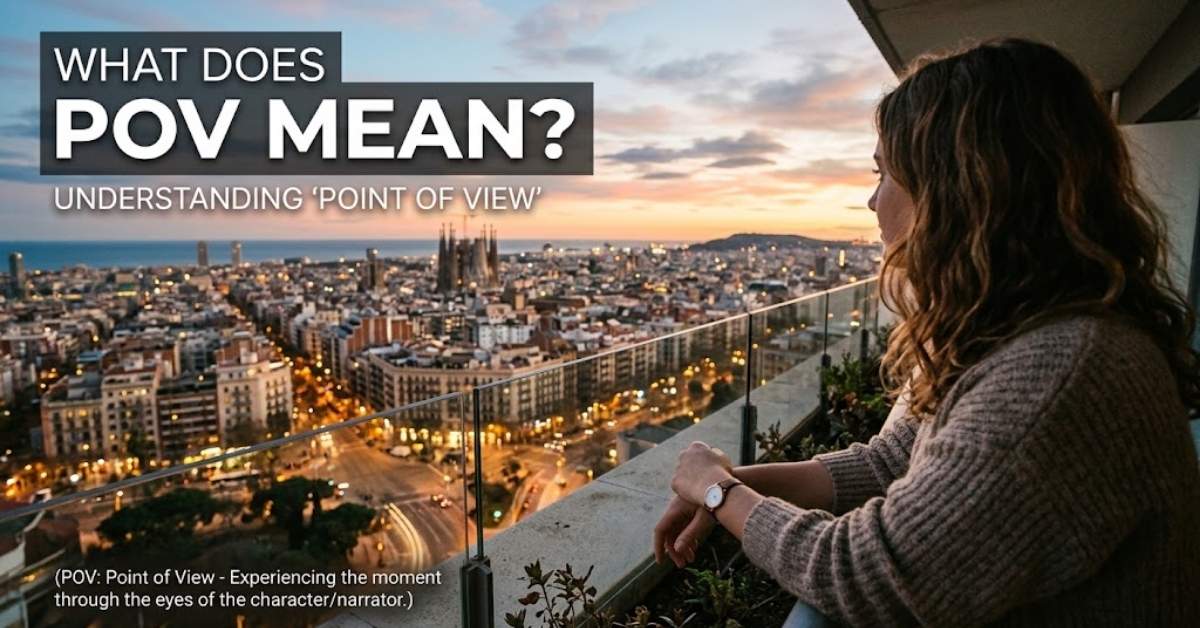
Ever scrolled past a video that starts with “POV” and wondered what you’re supposed to picture? Or sent it in a chat and got a confused “what?” back? You’re not the only one.POV stands for point of view. It describes the angle someone sees a moment from. Online, it also works as an invitation that says, “Imagine you’re standing right here with me.”
That’s the short answer. The rest of this guide shows how the POV meaning shifts between text messaging, TikTok, school, work, and family life. Stick around, because the common misunderstandings might surprise you.
POV – Quick Meaning
Simple Definition:
POV is an acronym for point of view, which is your personal perspective or viewpoint on something. It answers the question, “Who’s looking at this, and what do they see?”
On internet slang pages, POV also means a scenario-based caption. The creator drops you into a made up moment and lets you feel it.
Quick Examples:
Here are a few lines you’ll bump into daily:
- “POV: you just remembered you left the oven on.”
- “My POV on pineapple pizza? Totally fine.”
- “POV: the group chat goes silent after your joke.”
Each one hands you a viewpoint. Some tell you what to imagine, while others share an opinion.
Origin & Background
Traditional Meaning
Long before phones, point of view belonged to classrooms and film sets. In literature, it tells you who’s narrating. A story narrator might speak as “I” (first person point of view), as “you” (second person point of view), or as “he/she/they” (third person point of view).
Film and photography borrowed the idea too. A camera angle that shows what a character sees is called a POV shot. In journalism, it shapes whose side gets told first.
How It Became Internet Slang
Early forums and chat rooms shortened everything, and POV got trimmed along with “BRB” and “LOL.” Then short video changed the game around the late 2010s. Creators started filming from the viewer’s eye line and typing “POV:” across the screen.
Soon it wasn’t about cameras anymore. It became a POV format for mini stories, memes, and relatable moments. Today it’s a full POV trend across Instagram Reels, YouTube Shorts, and tweets.
Real-Life Conversations
1) WhatsApp Chat
Picture a group chat planning a weekend trip. Someone writes, “POV: I’m the only one who booked the tickets.” Everyone laughs, because it’s a playful way to say, “Hey, I did all the work.”
That’s casual communication at its finest. No long explanation, just a quick shared experience.
2) Instagram DMs
You reply to a friend’s story with, “POV: me watching you try that recipe.” It’s short and a little teasing. In Instagram DMs, this keeps the online interaction light and fun.
3) TikTok Comments
In TikTok comments, people write things like, “POV: your mom just called you by your full name.” Others pile on with their own versions. That’s where audience engagement really lives.
4) Text Message
A friend texts, “POV: Monday.” You know exactly what that means without a single extra word. In POV in texting, the tone and context do most of the talking.
5) Funny Friend Chat
Your best friend sends a photo of an empty fridge with “POV: adulting.” You send back a crying laughing emoji. That’s relatable humor, and it builds closeness fast.
Emotional & Psychological Meaning
1) It Makes People Feel Seen
When someone posts “POV: you’re tired but still smiling at work,” you think, “That’s me.” That tiny spark of emotional recognition feels good. It tells you other people live through the same thing.
2) It Creates Instant Connection
A shared feeling travels faster than a long caption. Strangers in a comment section become a little community in seconds. That’s emotional connection without the awkward small talk.
3) It Reflects Modern Identity
People use POV to show who they are. A glow up post, a confidence boost, or a self awareness joke all say, “This is my lens.” It’s a form of self expression that fits modern identity well.
4) It Feels Personal Without Being Too Deep
You can share a sore spot, like social anxiety, without writing a diary entry. The format keeps things soft and easy to approach. That’s why it feels safe for emotional honesty.
Usage in Different Contexts
POV doesn’t sound the same everywhere. A joke that kills in a group chat might flop in an email to your manager. Let’s walk through each setting so you can use it with confidence.
1) Social Media
How it works:
You type “POV:” and then describe a moment in second person. The viewer instantly becomes the main character. It’s immersive content in about eight words.
Example:
“POV: you finally get the last seat on the train.” Creators often film it from their own eye level. That adds viewer immersion and makes the clip feel real.
Purpose:
The goal is relatability. People like, comment, and share when they see themselves in the scene. For a content creator, that means better viewer engagement and wider reach.
2) Friends & Relationships
Example:
“POV: your crush finally replies after three hours.” Friends send this to each other when dating gets dramatic. It turns relationship tension into a laugh.
Example:
“POV: you and your best friend share the last fry.” It’s sweet and a bit silly. Small moments like this keep friendship fun.
3) Work or Professional Settings
Appropriate professional uses:
POV can work at the office when you mean its traditional meaning. A marketer might ask, “What’s the customer’s point of view?” A designer might study user experience from a first time visitor’s angle.
You’ll also see it in brand storytelling and presentations. Here it’s about customer experience, not memes.
Example:
“From the client’s point of view, the delay looks like a lack of planning.” That’s clear and respectful. It sounds natural in workplace communication.
Important:
Skip the meme style in emails to bosses, clients, or HR unless your office culture is very relaxed. When in doubt, write out “point of view.” It keeps your formal communication clean and safe.
4) Casual vs Serious Tone
Casual POV
Casual POV is playful and quick. Think “POV: you open your inbox and see 47 new emails.” It uses humor to ease work stress.
Serious POV
Serious POV shares a real perspective with care. “From my point of view, the deadline isn’t realistic.” No jokes needed. Both styles are valid when you match the tone to the room.
Common Misunderstandings
Plenty of people use POV a bit loosely. That’s fine online, but it can cause mix ups. Let’s clear up the big three.
1) Using POV for Something That Isn’t a Perspective
Some posts say “POV: new shoes” with a photo of shoes. That’s just a product shot, not a viewpoint. A real POV caption puts the viewer in a situation, like “POV: you finally found your size.”
This is incorrect usage that confuses people. The fix is simple. Add a person, a feeling, or a moment.
2) Confusing POV With Opinion
POV and opinion overlap, but they’re not twins. An opinion says what you think. A POV shows where you’re standing when you think it.
Example:
Opinion: “Group projects are annoying.” POV: “From where I sit, as the person who does all the slides, group projects feel unfair.” See the difference? The second one has a narrator and a reason.
3) Using It in Very Serious Situations Without Sensitivity
Dark humor has its place, but some topics aren’t a punchline. A careless POV can hurt real people. A little emotional intelligence goes a long way.
Avoid using it when:
- Someone is grieving or facing a health crisis
- A tragedy or disaster is in the news
- A person shared something vulnerable
- You’re not sure how your audience will take it
Comparison Table
Here’s a quick side by side to keep things straight:
| Term | What it means | Where you’ll see it | Tone |
| POV | The angle or scenario someone sees from | TikTok, Reels, chats | Casual, playful |
| Opinion | What someone thinks or believes | Debates, reviews | Mixed |
| Perspective | A broader way of understanding something | Essays, talks | Thoughtful |
| Point of view (spelled out) | Formal version of POV | Work, school, writing | Formal |
Key Insight:
POV is about where you stand. An opinion is about what you believe. Online, POV adds a third layer, which is where you want the viewer to stand.
Variations / Types of POV
You’ll spot many flavors of POV. Each one has its own vibe.
1) Funny POV
“POV: you say ‘you too’ when the waiter says enjoy your meal.” It’s observational humor at its best. Everyone has done it.
2) Romantic POV
“POV: he holds the door and says, ‘After you.'” These romantic moments feel warm and dreamy. They lean on nostalgia and hope.
3) Sad POV
“POV: you’re laughing in public but missing someone.” This taps into loneliness and disappointment. Done well, it feels honest rather than dramatic.
4) Confidence POV
“POV: you walk in knowing you belong.” It’s all about self respect and main character energy. People love a little boost.
5) Friendship POV
“POV: your friend shows up with snacks during a breakdown.” It celebrates group dynamics and loyalty. These get shared a lot.
6) Family POV
“POV: your mom asks if you’ve eaten while you’re eating.” That’s family humor with a side of family pressure. Parents, siblings, and cousins all get a cameo.
7) Student POV
“POV: you study all night and the exam asks something else.” Student life is full of relatable scenarios. Campus life gives endless material.
8) Work POV
“POV: the meeting could’ve been an email.” You’ll hear burnout, deadlines, and office culture in these. They work best among coworkers who share the pain.
9) Fashion or Beauty POV
“POV: you finally nail the winged eyeliner.” Makeup, outfit checks, and shopping hauls fit here. This is aesthetic content with a personal twist.
10) Cinematic POV
“POV: you’re walking through rain in slow motion.” These use cinematic edits and music for dramatic storytelling. The clip feels like a movie scene.
How to Respond When Someone Uses It
Replying well keeps the online conversation going. Match the energy and keep it simple. Here are a few ways to do that.
Casual Replies
- “Haha, so true.”
- “Literally me yesterday.”
- “Okay, that’s too real.”
These reply examples work in most chats. They’re short and friendly.
Funny Replies
- “POV: you read my diary.”
- “Stop calling me out like this.”
- “Who told you my Monday routine?”
A bit of witty humor keeps things fun. Just read the room first.
Mature / Confident Replies
- “Fair point. I see where you’re coming from.”
- “That’s a good way to look at it.”
Mature replies show emotional maturity. They work well when the topic is a bit deeper.
Private or Respectful Replies
If the post feels heavy, reply in a private message. Try, “I saw your post. Want to talk?” It’s a respectful move that shows care.
Not every POV needs a public reaction. Sometimes a quiet check in means more.
Regional & Cultural Usage
POV travels well, but local flavor changes how it sounds. Cross cultural communication has its quirks. Here’s a snapshot.
1) Western Culture
Common style:
In the US, UK, Canada, and across Europe, POV leans sarcastic and punchy. People love irony and therapy language, like “POV: you set a boundary.”
2) Asian Culture
Common style:
Creators often mix POV with family expectations, student pressure, and festival moments. The humor tends to be gentle and relatable. Group stories and school life show up a lot.
3) Middle Eastern Culture
Common style:
Family gatherings, hospitality, and social expectations often take center stage. Humor stays warm and respect based. Dramatic reactions are popular too.
4) Global Internet Usage
Because TikTok trends cross borders fast, one POV challenge can spread worldwide in days. Creators remix it with local jokes. That’s the beauty of global internet culture.
Tips to Write Better POV Captions
Want your own POV to land? Keep it tight. A good POV caption has one clear scene and one clear feeling.
- Start with a specific moment, not a vague idea
- Use “you” so the viewer steps in
- Keep it under 15 words when possible
- Match the video or photo to the words
Test it on a friend first. If they smile or nod, you’re on the right track. If they ask, “What’s that about?” rewrite it.
Conclusion
POV started as a storytelling tool and grew into a full digital language of its own. It can mean point of view, a scenario, or a way to connect. The trick is reading the context and picking the right tone.
Now it’s your turn. Which POV have you seen lately that made you laugh or nod? Drop it in the comments, share this guide with a friend who keeps asking what it means, and come back for more updates.
FAQs
1) What is the exact meaning of POV?
POV stands for point of view. It’s the angle or perspective someone uses to see a situation. Online, it also introduces a short scenario that puts you in the moment.
2) What does POV mean on TikTok?
On TikTok, POV on TikTok signals a scenario told from the viewer’s eyes. Creators use it to make clips feel immersive and relatable. Comments then fill with people sharing their own versions.
3) Is POV slang?
Yes and no. It’s a standard phrase in writing and film, but online it works as internet slang too. You’ll see both uses every day.
4) Can POV be used in texting?
Absolutely. In POV in text, it’s common among friends and group chats. Just keep it casual and watch your tone.
5) Is POV always used correctly online?
Not really. Many posts use it as a trendy label without a real viewpoint. That’s fine for fun, though it’s technically incorrect usage.
6) What’s the difference between POV and opinion?
An opinion says what you think. A POV shows where you’re standing when you think it. They often work together but aren’t the same thing.
7) Is POV formal or informal?
Both. The spelled out “point of view” works in formal communication, while the short “POV” suits casual communication. Pick the version that fits your audience.
