
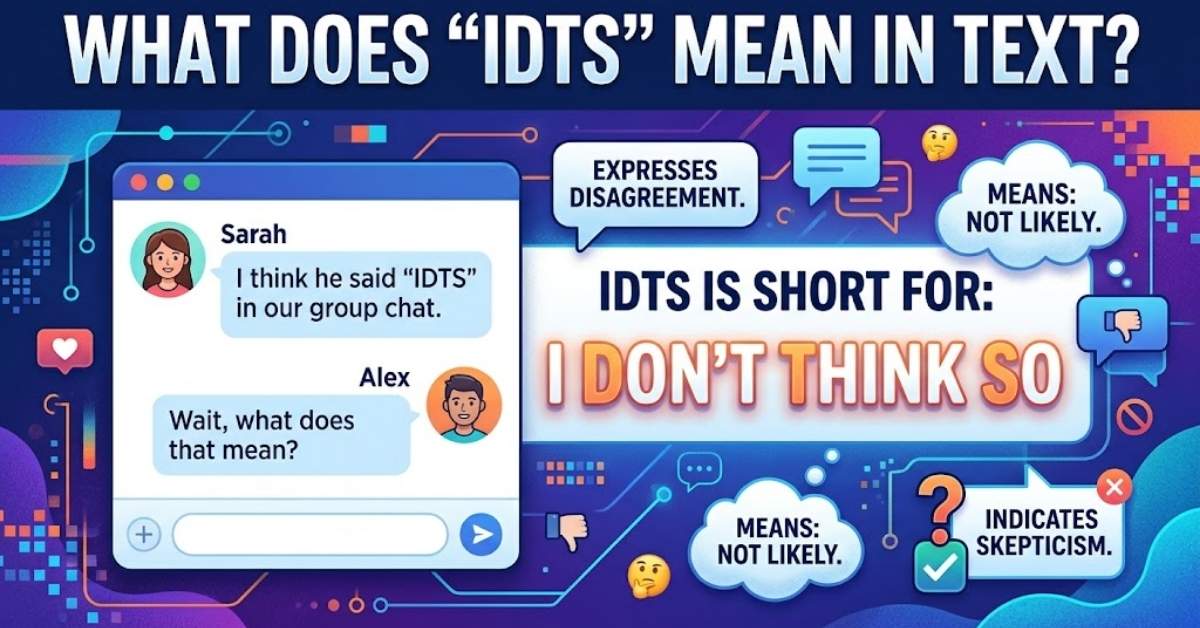
Someone just sent you “IDTS” and nothing else. Was it a typo? Are they annoyed with you?Relax. IDTS means “I don’t think so.” People use it to show doubt, disagreement, or skepticism without typing the full phrase.
This guide covers the IDTS meaning in text, how people use it, and how to reply. You’ll also learn when to skip it.
What Does IDTS Mean in Text & Chat?
IDTS is an informal abbreviation for “I don’t think so.” You’ll spot it in text messages, online chats, and social media comments.
Think of it as a quick, casual no. Sometimes it’s a soft “probably not” instead of a hard rejection.
The tone depends on what surrounds it. A laughing emoji makes it playful, while a bare “IDTS.” can sound blunt.
Featured Snippet Answer:
IDTS stands for “I don’t think so.” It’s internet slang used in texting to express doubt or polite disagreement with a statement or question.
For example, a friend asks, “Is the gym open on Sunday?” You answer, “IDTS, I think it closes early.”
That’s the whole idea. Short, casual, and easy to read once you’ve seen it.
Full Form, Stands For & Short Meaning of IDTS
The IDTS full form is “I don’t think so.” Each letter maps to a word: I, Don’t, Think, So.
It’s an acronym in the loose sense, though technically it’s an initialism because you say the letters one by one. Most people just call it text slang.
Short Meaning:
Short meaning: probably not, I doubt it, I disagree.
It sits between a firm “no” and an uncertain “maybe.” That middle ground is exactly why people love it.
Origin, History & First Known Use of IDTS
Nobody can point to the first person who typed IDTS. Slang like this rarely has a paper trail.
Many slang sites place it in the early 2000s, when SMS character limits and instant messaging services pushed people to shorten everything. I couldn’t verify an exact first use, so treat that date as a reasonable guess.
The logic fits, though. Texting culture rewarded typing convenience, and time saving abbreviations like IDK, BRB, and IDTS spread fast.
As mobile phones got popular, these shortened expressions moved from online chat rooms into everyday talk. The internet language evolution never really stopped.
How People Use IDTS in Daily Conversations
Most of the time, IDTS answers a question or reacts to a claim. You’ll find it in IDTS in daily conversations, private chats, and online discussions.
People reach for it when typing the full phrase feels like too much effort. It’s about speed and a relaxed vibe.
You can also use it for predictions, debates, and personal opinions. It signals that you see things differently.
Texting Examples
Here are a few sample chats, so you can see IDTS texting examples in action:
- “Will he reply today?” → “IDTS, he’s busy all week.”
- “Think we’ll win?” → “IDTS 😅 their defense is solid.”
- “Is it going to rain?” → “IDTS, the sky looks clear.”
Notice how each reply adds a reason. That makes the message interpretation easier for the other person.
Social Media Usage
On social media, IDTS often shows up in comments under predictions, rumors, or hot takes. Someone posts “This trend is here to stay,” and a commenter writes “IDTS.”
It’s short, a bit cheeky, and keeps the thread moving. You won’t see it in long, serious posts very often.
Casual Situations
Picture planning a weekend trip. Your friend says, “Everyone will say yes.” You type, “IDTS, Sam hates early mornings.”
That’s friendly communication at its best. You disagree, but nobody feels attacked.
IDTS Meaning Across WhatsApp, Instagram, TikTok & Snapchat
The meaning doesn’t change from app to app. What changes is the tone and the audience.
Faster, more public platforms lean playful or dismissive. Private chats lean neutral and friendly.
On WhatsApp, IDTS meaning in WhatsApp messages is straightforward. It’s usually a quick answer in a private chat or group thread.
Family groups might not know it, though. If your aunt asks a question, spell it out.
On Instagram, you’ll see IDTS in Instagram direct messages and Instagram comments. Replies to Stories often carry it too.
Add an emoji if you want to soften it. “IDTS 😂” lands lighter than “IDTS.”
TikTok
On TikTok, IDTS appears in TikTok comments under prediction videos, hot takes, and “guess what happens next” clips. It often reads as skepticism.
Viewers use it to push back without starting a full argument. It’s quick, and it fits the fast pace.
Snapchat
On Snapchat, Snapchat conversations move fast and disappear fast. IDTS fits perfectly as a rapid reply.
Friends use it for plans, gossip, and jokes. The casual tone is the default here.
Different Meanings of IDTS in Other Fields
In everyday texting, IDTS means “I don’t think so.” That’s the meaning you’ll meet 99 percent of the time.
Outside chat, some companies, schools, or technical documents may use IDTS as an internal abbreviation for something else. The meaning depends entirely on that organization.
A few low quality sites also claim it can mean “I don’t understand.” I couldn’t find solid proof, so I wouldn’t lean on that reading.
If you see IDTS in a professional file or product, check the glossary first. Conversation context is your best clue.
Common Confusions, Mistakes & Wrong Interpretations
The biggest mix-up is reading IDTS as rude. It isn’t, but a blunt reply can feel sharp when you’re already sensitive.
Another trap is guessing the meaning without checking the context clues. A single word of slang can flip depending on who sends it.
Common Mistakes
Here’s what trips people up most:
- IDTS vs IDK: IDK means “I don’t know.” IDTS means “I don’t think so.” One shows lack of knowledge, the other shows disagreement.
- “I don’t think” vs “I don’t think so”: The first needs more words to finish. The second is a complete answer.
- Using it with the wrong audience: Great with friends, risky with a boss.
- Ignoring emojis: “IDTS 😂” and “IDTS.” send different signals.
- Hunting for a hidden meaning: Most of the time, there isn’t one.
If you’re unsure, ask. “Did you mean you doubt it?” clears up an IDTS misunderstanding fast.
Similar Terms, Alternatives & Related Slang
IDTS has plenty of cousins. Knowing them helps you read modern internet slang with confidence.
Here’s a quick rundown of related slang and abbreviations:
- IDK means I don’t know.
- IMO means in my opinion.
- IMHO means in my humble opinion.
- TBH means to be honest.
- NGL means not gonna lie.
- IDC means I don’t care.
- SMH means shaking my head.
- LOL means laugh out loud.
- BRB means be right back.
- OMG means oh my god.
You may also run into ISTG, HN, and DTM in chats. They look similar but mean different things, so check each one before guessing.
For plain-English alternatives, try “I doubt it,” “probably not,” or “not really.” They carry the same meaning in a polite way.
Examples of IDTS in Real Chat Situations
Examples make slang stick. Here are three IDTS in real chats scenarios.
Scenario one: weekend plans. Your friend writes, “Everyone’s coming Saturday!” You reply, “IDTS, half the group has exams.”
Scenario two: sports talk. A group chat debates a match. Someone says, “We’ll crush them.” Another answers, “IDTS 😂 remember last time?”
Scenario three: work chat on a casual team. A coworker asks, “Will the client approve this by Friday?” You write, “IDTS, they usually take a week.”
In each case, IDTS opens the door to a short follow-up. It rarely ends the conversation.
How to Reply When Someone Says IDTS
Your reply depends on conversation context. Are they joking, doubtful, or just being honest?
Match their energy. If they’re light, stay light. If they’re serious, give a real answer.
Below are appropriate replies for every mood. Pick what fits your relationship.
Casual Replies
- “That’s fair.”
- “Maybe you’re right.”
- “I guess we’ll see.”
These keep things easy and relaxed.
Friendly Replies
- “Let’s wait and see.”
- “We’ll find out soon.”
- “Okay, what makes you think that?”
They show you’re open to the other opinion.
Funny Replies
- “Challenge accepted.”
- “Prove you wrong? Easily.”
- “Famous last words.”
Use these with people who enjoy a bit of banter.
Formal Replies
- “Thank you for your perspective.”
- “I understand your concern.”
- “That’s certainly possible.”
These work in professional email etiquette or with someone you don’t know well.
Is IDTS Still Popular? Trends & Online Usage
IDTS isn’t a headline slang term like some viral phrases. It’s a steady, useful shortcut.
Short forms for common phrases tend to stick around. They’re practical, not trendy.
Usage Trends
I couldn’t find reliable public data on IDTS usage numbers. Search interest for slang meanings usually spikes whenever people see a term in a new app or comment section.
That points to steady, low key use rather than a boom. It’s more of a quiet regular than a star.
Is Usage Growing or Declining?
It looks stable. There’s no clear sign of a sharp rise or fall.
Growing slang terms usually come with memes and viral moments. IDTS doesn’t have either, so it simply keeps going.
Who Uses It Most?
Teenagers and young adults use it most, especially frequent texters and social media users. Plenty of older internet users pick it up from group chats too.
If you’re in a chat full of students or gamers, you’ll see it more often. In a chat with grandparents, probably not.
Quick Facts About IDTS
Here’s the short version of everything above:
| Detail | Answer |
| Full form | I don’t think so |
| Type | Informal abbreviation (initialism) |
| Tone | Neutral, playful, or blunt, depending on context |
| Common platforms | WhatsApp, Instagram, TikTok, Snapchat, SMS, X (Twitter) |
| Best for | Friends, casual chats, comments |
| Avoid in | Formal emails, job applications, official documents |
| Often confused with | IDK (I don’t know) |
When Should You Use IDTS?
Use it when you’re chatting with friends and want a fast, relaxed reply. It works well for predictions, plans, and playful debates.
Skip it when you’re writing to a manager, a client, or anyone who expects clear language. Type “I don’t think so” in full instead.
A good test: would you say “I don’t think so” out loud in this chat? If yes, IDTS probably fits.
Conclusion
IDTS means “I don’t think so.” It’s a short, casual way to show doubt or polite disagreement in digital communication.Read the tone, check the emojis, and look at who’s talking. That’s all it takes to decode it.
Have you ever misread a slang term and gotten the wrong idea? Share your story in the comments, and send this guide to a friend who’s still guessing.
FAQs
What does IDTS mean on Snapchat?
On Snapchat, IDTS still means “I don’t think so.” It’s a quick reply in a fast chat.Friends use it for plans, gossip, and jokes.
What does IDTS mean on Instagram?
On Instagram, it means the same thing. You’ll see it in DMs and comment threads.Emojis often set the tone, so read them closely.
Is IDTS rude?
Not by itself. It’s a direct answer, which can feel blunt without a friendly tone.Add a reason or an emoji, and it softens right away.
What does IDTS mean from a girl?
It means “I don’t think so,” just like anywhere else. Gender doesn’t change the meaning.Look at the tone and the conversation instead. That’s where the real signal lives.
What does IDTS mean from a guy?
Same answer: “I don’t think so.” He’s expressing doubt or mild disagreement.If it feels cold, check how he usually texts. Some people are just short and direct.
Is IDTS the same as IDK?
No. IDK means “I don’t know,” which signals uncertainty.IDTS means “I don’t think so,” which signals disagreement or doubt.
Can IDTS be used in professional communication?
It’s best to avoid it. IDTS is informal language, and clear writing builds trust at work.Say “I don’t think so” or “I don’t believe that’s the case” instead.
Is IDTS still used in 2026?
Yes. It’s still in use across texts, comments, and group chats, though I couldn’t find hard usage numbers.It’s practical slang, so it hangs around without making noise.
