

Have you ever seen someone comment “304” on social media and wondered what it means? This simple number has a hidden meaning in internet slang. People often use it as an insult linked to the word “hoe” when the number is turned upside down on a calculator. You may spot it in memes, comments, or online arguments. But why do people use this code, and what are they really trying to say? The answer depends on the context.
Not every 304 has an offensive meaning. In technology, HTTP 304 is a status code that tells a browser a resource has not changed. The number can also appear in phone numbers, records, and other settings. Knowing the difference helps you avoid awkward misunderstandings. In this guide, you’ll learn the slang meaning, where it comes from, how people use it online, and how to respond when someone uses it in a conversation.
Definition & Core Meaning
The 304 meaning in slang refers to a coded insult that resembles the word hoe when you flip the number upside down. People often use this numeric code to insult women or shame their perceived sexual behavior.
You may see 304 in social media comments, captions, memes, and online arguments. Although it looks like an ordinary number, its slang meaning can be offensive.
- 304 slang: A numeric substitute for a derogatory word.
- Numeric code: A number that represents a hidden word or message.
- Coded insult: An indirect way to insult or embarrass someone.
- Internet slang: Informal language used in online conversations.
For example:
- Person A: Why are people calling her 304?
- Person B: It’s an insulting slang term used to shame women.
Remember, context matters. The number can have a completely different meaning in technical or everyday situations.
Common Meanings & Other Possible Meanings of 304
The meaning of 304 depends on where you see it and how someone uses it. In online slang, it usually carries a negative meaning. However, the same number also appears in technology, telephone systems, and everyday references.
Here are five common interpretations to help you understand the difference:
- Slang: A coded insult aimed at women.
- Technology: An HTTP status code that means a webpage hasn’t changed.
- Telephone: The area code for parts of West Virginia in the USA.
- Numerical reference: A room, page, item, or model number.
- Online harassment: A coded insult used to shame or target someone.
For example, seeing 304 in a web development report doesn’t mean someone is using slang. Likewise, seeing it in a hostile comment may suggest an insult.
Always consider the surrounding words, platform, and conversation before deciding what 304 means.
1. Slang / Internet Meaning
The most common 304 meaning slang refers to a derogatory insult that resembles hoe when viewed upside down on a calculator. The term often targets women and makes judgments about their sexual behavior.
People use this numeric substitute in comment sections, captions, memes, and private messages. Some use it to provoke reactions or disguise offensive language.
For example:
- Comment: She’s acting like a 304.
- Reply: That’s a disrespectful thing to say about someone.
The slang can appear playful, sarcastic, or aggressive. However, calling someone a 304 often carries a shaming message, even when the sender claims it’s a joke.
Keep these points in mind:
- It isn’t a neutral compliment.
- It can promote harmful stereotypes.
- Its meaning depends on intent and context.
- Using a number doesn’t make an insult harmless.
Understanding this online slang helps you recognize disrespectful language and respond appropriately.
2. HTTP Status Code (Tech Meaning)
In web development, HTTP 304 means 304 Not Modified. Unlike the slang term, this technical code has no insulting meaning. It tells a browser that a requested resource hasn’t changed since the browser last checked it.
Websites use this response to support webpage caching. Instead of downloading the entire resource again, a browser can reuse its stored copy when appropriate.
This process can reduce unnecessary data transfers and improve loading efficiency. It also matters in SEO because caching affects how browsers retrieve website resources.
For example:
- Developer A: Why did the server return 304?
- Developer B: The resource hasn’t changed, so the browser can use its cached copy.
The main differences are simple:
- 304 slang: An offensive numeric code in certain conversations.
- 304 Not Modified: A standard HTTP status code.
- Context: The surrounding discussion tells you which meaning applies.
If you encounter 304 in server logs, browser tools, or SEO reports, the technical meaning is usually the relevant one.
3. Area Code
The number 304 is also a telephone area code in the United States. It serves West Virginia, along with the state’s overlapping 681 area code.
In this context, 304 identifies a telephone numbering region rather than an insult. You might encounter it in phone numbers, business listings, contact details, or calls from the state.
For example:
- Person A: I got a call from a number with the 304 area code.
- Person B: That area code is associated with West Virginia.
Here are a few things to remember:
- The number can appear at the beginning of a US phone number.
- It doesn’t automatically indicate spam or harassment.
- Its presence doesn’t give you the caller’s exact location.
- The slang meaning doesn’t apply to every use of 304.
Context makes the difference. A telephone number containing 304 has a practical purpose, while a hostile social media comment may use the number as a coded insult.
4. Numerical Reference
Sometimes, 304 is simply a number. It might identify a page, room, product, item, model, or other reference in everyday life. In these cases, it has no hidden slang meaning.
For example, a hotel guest might stay in Room 304. A student might read page 304, while a customer might buy a product labeled Model 304.
Consider this conversation:
- Person A: My appointment is in Room 304.
- Person B: Got it. I’ll meet you there.
Nothing about this exchange suggests an insult. The number serves only as a label.
Before interpreting 304 as internet slang, look at the surrounding information. Is someone discussing a room number, a product, or an online argument? That detail can change everything.
Quick tip: Don’t assume every appearance of 304 carries an offensive meaning. Context helps you distinguish ordinary numbers from coded language.
5. Coded Online Harassment
Some people use 304 as a coded insult to shame or target women online. They may choose the number instead of writing the actual word because they believe it will attract less attention from moderation filters.
This practice can contribute to coded harassment, online shaming, and cyberbullying. It may appear in comment sections, memes, viral videos, or online relationship conflicts.
For example:
- Person A: Why are people commenting 304 under her video?
- Person B: They may be using it to insult or shame her.
However, the number alone doesn’t prove harassment. A technical discussion or ordinary numerical reference may use 304 without any harmful intent.
Keep these points in mind:
- Coded language can still hurt people.
- Filter evasion doesn’t remove an insult’s meaning.
- Repeated targeting may amount to online harassment.
- Platform policies vary, so enforcement isn’t identical everywhere.
Responsible communication means judging the context rather than the number alone.
Core Meanings of 304 (Slang)
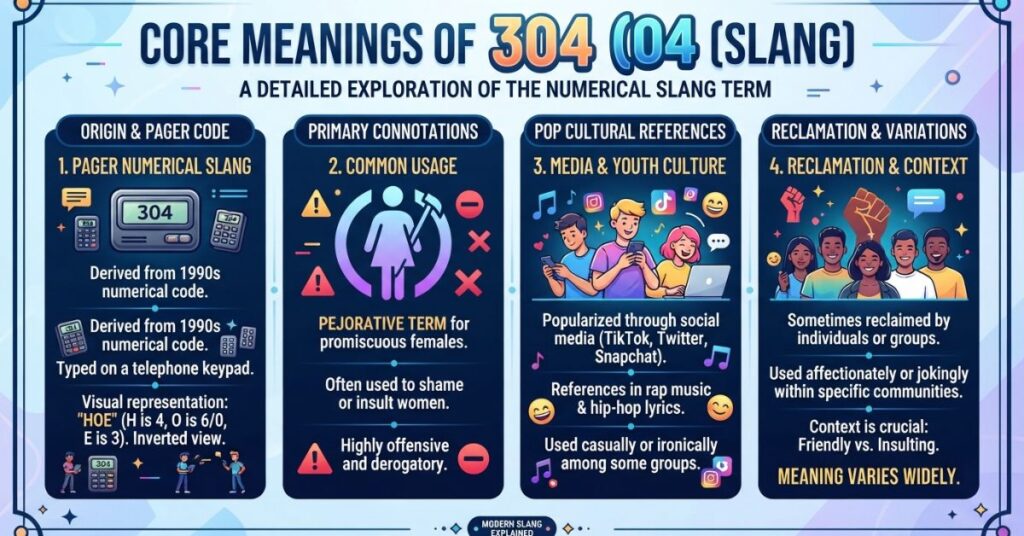
The core 304 meaning in internet slang centers on a derogatory word disguised as a number. When flipped upside down, 304 resembles hoe, an insulting term often used to judge a woman’s perceived sexual behavior.
People may use it as shorthand in online arguments, gossip, captions, or memes. Some use it to provoke others, while some repeat the term without understanding its full meaning.
Here are the main ideas behind 304 slang:
- Numeric substitute: A number that represents an offensive word.
- Derogatory term: Language used to insult or demean someone.
- Sexual shaming: An attempt to judge or humiliate someone over perceived sexual behavior.
- Coded language: A disguised expression that readers familiar with the slang can recognize.
For example:
- Person A: What does 304 mean in that comment?
- Person B: It’s a coded insult, not a compliment.
The meaning can vary with context, but its common slang use carries a disrespectful implication. Recognizing it helps you understand online conversations without adopting harmful language yourself.
Why 304 Means That
The slang meaning comes from a simple visual trick called calculator spelling. When you turn the number 304 upside down, its digits can resemble the letters in hoe when viewed in the appropriate orientation.
This trick belongs to a wider tradition of upside-down calculator words and numeric codes. People use numbers to represent letters, creating messages that may look confusing at first glance.
The same idea appears in other forms of coded language. A number can become a joke, a shorthand expression, or an insult when people agree on its hidden meaning.
For example:
- Person A: Why are people using 304 instead of the word?
- Person B: The number resembles the word when flipped upside down.
The visual trick explains the slang’s meaning, but it doesn’t make the term harmless. When someone uses it to shame another person, the message can still cause emotional harm.
Remember that a number’s meaning depends on how people use it. In a calculator joke, it may be wordplay. In a hostile comment, it can become a direct insult.
Simple Examples
Seeing 304 in an actual conversation makes its slang meaning easier to understand. The following examples show how people may use the number in online comments, memes, and arguments.
- Direct insult: Someone calls a woman a 304 to shame her.
- Comment section slang: A user writes 304 under someone’s photo to provoke a reaction.
- Meme usage: A joke includes 304 as a reference to the insulting slang.
- Ironic use: Someone criticizes people who casually call others 304.
- Coded harassment: A person uses the number to disguise an offensive comment.
Consider these short exchanges:
- Person A: Why did he call her a 304?
- Person B: He was using a derogatory slang term.
Or:
- Person A: Is 304 always an insult?
- Person B: No. It depends on the context.
These examples show why you shouldn’t judge a message by its numbers alone. A hostile comment may reveal an insulting intent, while a technical reference may have no connection to slang.
If you encounter the term directed at someone, consider whether the message targets or humiliates them. You can understand its meaning without repeating the insult.
Historical & Cultural Background

Numeric slang shows how people turn ordinary numbers into messages with hidden meanings. The 304 slang term follows this pattern through calculator spelling, online shorthand, and the spread of internet culture.
People have used number-based wordplay in informal communication for decades. As digital communication grew, coded expressions also appeared in forums, chat rooms, social media posts, and memes.
Today, 304 may appear in online arguments, viral videos, captions, and conversations about relationships. Some people use it knowingly, while others encounter it through trending content without understanding its background.
Its cultural meaning also depends on how people interpret the term. Some recognize it immediately as an insult, while others may mistake it for an ordinary number.
Understanding this background helps build digital literacy. You can recognize coded language, interpret online messages more carefully, and avoid repeating offensive expressions without knowing what they mean.
Origins of Numeric Slang
Numeric slang developed from a simple idea: numbers can stand in for letters, sounds, or words. Calculator spelling became a familiar form of wordplay because certain digits resemble letters when viewed upside down.
This type of playful code existed before modern social media. During the early digital culture era, people also used shorthand and number-based expressions in informal messages.
However, the exact history of 304 slang isn’t firmly established by the competitor article alone. Claims that the term began in a specific decade or community need reliable historical evidence.
Here are the main concepts behind numeric slang:
- Calculator spelling: Using digits to create words through visual resemblance.
- Numeric code: A number that represents a hidden message.
- Shorthand: A shorter way to express an idea.
- Coded language: Words or symbols that require shared knowledge to understand.
For example:
- Person A: Why do people turn numbers upside down?
- Person B: Some digits resemble letters, so the result can spell a word.
The technique itself is easy to understand. The history of each specific slang term, however, requires separate evidence.
How 304 Entered Internet Culture
The slang meaning of 304 spread through the broader use of coded expressions online. Social media, forums, memes, and short-form videos give people quick ways to share slang with large audiences.
A term can move from one online community into another through reposts, comments, and viral trends. People may then copy it without knowing its origin or how offensive it sounds.
The number can also appeal to users who want to disguise a derogatory word. Some may believe numeric substitutes can bypass moderation filters, although platforms differ in how they detect and handle offensive content.
For example:
- Person A: Why is everyone commenting 304 on this video?
- Person B: It may be a slang trend, but people are using it as an insult here.
A few factors can influence its spread:
- Viral videos introduce expressions to new audiences.
- Comment sections repeat short and memorable phrases.
- Memes make slang easy to share.
- Online arguments can encourage provocative language.
Popularity doesn’t make a term harmless. Understanding its meaning helps you decide whether a post uses it as wordplay, criticism, or coded harassment.
Cultural Interpretations
The meaning of 304 can vary depending on someone’s online experience, language, and cultural background. People familiar with Western internet culture may recognize it as an insulting slang term, while others may see only an ordinary number.
However, it’s important not to assume that everyone in a region interprets the term the same way. Asian online spaces, Middle Eastern cultures, African cultures, Latin cultures, and Indigenous and traditional cultures all include diverse communities with different experiences of digital language.
Here are a few factors that shape interpretation:
- Online exposure: People who frequently encounter a slang term may recognize it faster.
- Language and community: Local slang can influence how people interpret unfamiliar expressions.
- Cultural awareness: Understanding a term’s social meaning helps prevent accidental offense.
- Intent and context: A technical reference differs from a personal insult.
For example:
- Person A: Is 304 offensive everywhere?
- Person B: Its meaning depends on context, but its common slang use is derogatory.
In global digital culture, responsible communication starts with understanding the words and codes people use. Avoid broad cultural assumptions, and consider the actual conversation before deciding what a number means.
Emotional & Psychological Meaning

The 304 meaning goes beyond a number when people use it as an insult online. It can carry emotional weight because it often targets someone’s character, choices, or sexual reputation.
People may use this slang to shame others or make them feel small. However, the impact depends on the situation, the relationship, and the intention behind the comment.
The term can affect someone’s confidence, especially when others repeat it publicly.
- Shame: It can make someone feel embarrassed or judged.
- Emotional harm: Repeated insults may cause stress or hurt.
- Social pressure: People may use the term to control how others behave.
- Online safety: Understanding the slang helps you recognize harmful communication.
For example:
- Person A: Why are people calling her 304?
- Person B: They’re using it as an offensive slang term.
- Person A: That’s disrespectful. They shouldn’t judge her like that.
Remember, a person’s worth isn’t defined by an online insult.
Shame & Judgment
The 304 meaning slang often connects to shame and judgment. People may use it to insult someone based on their perceived sexual behavior or reputation.
The term can turn a personal opinion into public humiliation. This is especially harmful when people post it in comments, memes, or group chats to embarrass someone.
Sometimes, users claim they’re joking. However, a joke can still hurt when it targets someone’s dignity.
Here are common ways this slang may appear:
- Public shaming: Someone posts the term under another person’s photo.
- Online arguments: People use it to attack someone during a disagreement.
- Peer pressure: A group repeats the insult to make someone feel excluded.
- Harassment: Users keep posting it after the person asks them to stop.
Conversation example:
- Alex: Why did they call her that in the comments?
- Sam: They’re trying to shame her.
- Alex: That’s not funny. It’s just disrespectful.
Avoid using this term to label or judge people.
Identity & Self-Worth
The 304 meaning can affect how someone feels about their identity and self-worth. When people repeatedly use a degrading label, the target may start questioning how others see them.
This does not mean the insult says anything true about that person. It reflects the language and judgment of the person using it.
Your identity includes your values, interests, experiences, and choices. One offensive word cannot define all those things.
If someone directs this slang at you, consider these steps:
- Don’t accept the label: An insult does not determine your worth.
- Set boundaries: Tell the person their language is unacceptable.
- Limit contact: Mute or block accounts that repeatedly target you.
- Seek support: Talk to someone you trust if the comments upset you.
- Report abuse: Use platform tools when the behavior becomes harassment.
Conversation example:
- Mia: Someone called me 304 online. I feel awful.
- Zoe: That word doesn’t define you. They’re choosing to insult you.
Treat others with respect, even when you disagree with them.
Mindset & Symbolism
The 304 meaning slang also shows how people use numbers to communicate hidden or indirect messages. When the number is turned upside down on a calculator, it can resemble the word hoe. Online, some people use this resemblance as a coded insult.
This is an example of how internet culture turns ordinary numbers into slang. The meaning depends on context, not just the digits themselves.
The number may appear in memes, comments, captions, or private messages. Some people use it to provoke reactions, while others repeat it without understanding its meaning.
Keep these points in mind:
- Symbolism: A number can represent a word or idea.
- Intent: The sender may be joking, insulting someone, or trying to provoke.
- Context: The surrounding message helps reveal the intended meaning.
- Impact: A coded insult can still hurt, even when it looks harmless.
Conversation example:
- Jay: Why did someone comment 304 on her video?
- Lee: It may be a coded insult. Check the context before assuming.
Understanding online slang helps you interpret messages without automatically accepting harmful language.
Different Contexts & Use Cases
The 304 meaning changes with the context in which you see it. In slang, it is often a derogatory term used to shame or insult someone.
However, not every use of the number 304 has this meaning. It can also refer to a model number, an area code, or a technical code.
Look at the surrounding words before deciding what someone means. The platform and topic can offer useful clues.
Common contexts include:
- Personal life: Someone uses the slang during a private conversation or argument.
- Social media: A user posts it under a video, photo, or meme.
- Relationships: Someone uses it during jealousy, gossip, or a disagreement.
- Professional settings: The number may appear in a technical or business context without any slang meaning.
Conversation example:
- Chris: What does 304 mean here?
- Taylor: It depends. Is this a social media comment or a technical document?
Context helps you avoid misunderstanding the number or spreading an offensive interpretation.
Personal Life
In personal conversations, the 304 meaning slang may appear in jokes, arguments, or discussions about someone’s reputation. Friends might use the term casually, but that doesn’t automatically make it harmless.
Some people use coded slang to tease others. Others use it to embarrass someone or question their character. The difference often depends on the relationship, tone, and whether everyone feels comfortable.
Even between friends, a label can cross a line. If someone seems hurt, don’t dismiss their feelings by saying it was only a joke.
Here are a few examples:
- Private argument: Someone uses 304 to insult another person.
- Group chat: Members repeat the term to mock someone who isn’t present.
- Casual discussion: A person asks what the number means after seeing it online.
- Boundary setting: Someone asks others to stop using the insult.
Conversation example:
- Sam: Why did you call her 304?
- Alex: I was joking.
- Sam: She didn’t find it funny. You should apologize.
Respect matters in private conversations just as much as it does online.
Social Media
On social media, the 304 meaning often refers to a derogatory slang term. You may see it in comment sections, memes, captions, short-form videos, or online arguments.
Some users write the number instead of the actual word because they expect other people to recognize the code. Others use it to provoke reactions or avoid obvious wording that moderation filters might detect.
However, using numbers does not make an insult harmless. Platforms may still treat repeated targeted abuse as harassment, depending on their rules and the circumstances.
Watch for these common uses:
- Comments: A user posts 304 under someone’s picture.
- Memes: The number appears in a joke about dating or reputation.
- Videos: A creator discusses the slang or uses it for shock value.
- Online arguments: People use it to attack someone instead of addressing the issue.
Conversation example:
- Ava: Why is everyone commenting 304?
- Noah: They’re using it as an insult.
- Ava: I’ll report the comments if they keep targeting her.
If you encounter the term, check the context before interpreting it. Report repeated harassment when appropriate.
Relationships
In relationships, the 304 meaning slang may appear during jealousy, mistrust, gossip, or heated arguments. Someone might use it to question a partner’s loyalty or insult a person they dislike.
This language can damage trust because it attacks someone’s character instead of discussing the actual problem. It may also encourage sexual shaming or controlling behavior.
A disagreement does not justify humiliating another person. Healthy relationships depend on honest communication, clear boundaries, and mutual respect.
If someone uses this term during a conflict, try to focus on the real issue.
- Explain your concern: Discuss the behavior that upset you.
- Avoid name-calling: Use clear words instead of degrading labels.
- Set boundaries: Say when a comment feels disrespectful.
- Look for patterns: Repeated insults may signal an unhealthy communication pattern.
Conversation example:
- Ryan: You called her 304 because you were jealous.
- Chris: I was angry, but that wasn’t fair.
- Ryan: Talk about what bothered you instead of insulting her.
Strong relationships make room for difficult conversations without personal attacks.
Professional or Modern Usage
The 304 meaning depends heavily on where you see it. In casual online slang, it can be an offensive label. In professional or technical settings, the same number may have a completely different meaning.
For example, web developers use HTTP 304 Not Modified as a status code. It tells a browser that a resource has not changed, so a cached version can be used when appropriate. The number can also appear in product codes, records, or other numbered systems.
Because meanings differ, avoid assuming the slang definition applies everywhere.
- Workplace communication: Don’t use 304 as a personal insult toward a coworker.
- Web development: HTTP 304 refers to a technical response.
- Business records: It may simply identify an item, model, or reference.
- Professional writing: Spell out the intended meaning when confusion is possible.
- Modern online culture: Recognize that coded slang can still offend people.
Conversation example:
- Developer: The server returned HTTP 304.
- Colleague: Does that mean the page hasn’t changed?
- Developer: Yes. It’s a technical status code, not internet slang.
In professional settings, use clear language and judge the number by its context.
Hidden, Sensitive, or Misunderstood Meanings
The 304 meaning can be confusing because the number has different uses. In internet slang, it often refers to a derogatory term used to insult or shame someone. The meaning can feel hurtful, especially when people use it to attack someone’s reputation.
However, not every use of 304 is offensive. The number may appear in technology, phone numbers, product codes, or everyday conversations. You need to consider the surrounding message before deciding what it means.
People may also use the slang jokingly, but the impact depends on the situation.
- Hidden meaning: The number can represent a word when flipped upside down.
- Sensitive meaning: It may target someone’s character or sexual reputation.
- Technical meaning: HTTP 304 refers to a resource that has not changed.
- Context matters: The same number can carry different messages.
Conversation example:
- Alex: Why did someone comment 304 on her post?
- Sam: It may be an insult, depending on the context.
Common Misunderstandings
One common misunderstanding about the 304 meaning is that the number always refers to internet slang. This is not true. Its meaning changes with the topic and situation.
Some people also assume that everyone who uses 304 intends to offend someone. However, a person might be discussing the slang, asking about its meaning, or using the number in a technical context.
Another mistake is thinking that coded language makes an insult harmless. A number can still hurt someone when people use it to shame or target them.
Keep these points in mind:
- It is not always slang: Technical and numerical uses are common.
- Intent can differ: Someone may explain the term rather than insult anyone.
- Jokes can hurt: A playful intention does not guarantee a positive impact.
- Context provides clues: Read the full message before making assumptions.
Conversation example:
- Mia: Does 304 always mean an insult?
- Leo: No. It depends on where and how someone uses it.
What People Miss
People often focus on the number itself and overlook the message around it. Understanding the 304 meaning requires more than recognizing the digits. You should also consider who wrote the message, where it appeared, and whom it targets.
For example, a comment under someone’s photo may use 304 as an insult. In a web development discussion, HTTP 304 has a technical meaning instead.
People may also miss the emotional impact of coded language. An insult does not become harmless simply because it uses numbers instead of letters.
Here are a few important details:
- Audience: Who is likely to read the message?
- Tone: Does the message seem playful, angry, or disrespectful?
- Purpose: Is the person explaining, joking, or attacking someone?
- Impact: Could the message embarrass or hurt another person?
Conversation example:
- Ava: It’s only a number. Why are people upset?
- Noah: The meaning behind it can make it offensive.
When Meaning Changes
The 304 meaning can change based on the platform, conversation, and subject. In a social media comment, it may refer to a derogatory slang term. In a technical conversation, it may refer to HTTP 304 Not Modified.
The same number can also appear in phone numbers, product labels, room numbers, or other records. These uses do not automatically carry a hidden message.
Context helps you understand what someone intends. Look at the words around the number before deciding how to respond.
Consider these examples:
- Social media: Someone uses 304 to insult another person.
- Technology: A developer discusses an HTTP 304 response.
- Everyday life: A label uses 304 as an item number.
- Private messages: Friends discuss the slang or use it jokingly.
Conversation example:
- Ben: I saw 304 in a comment. Is it offensive?
- Ella: It can be, but we need to check the context first.
Comparison Section
The 304 meaning becomes easier to understand when you compare its different uses. The number may represent internet slang, a technical response, or a simple numerical reference.
These meanings are not interchangeable. The words around the number usually reveal which interpretation fits the situation.
| Context | Meaning of 304 | Example |
| Internet slang | A derogatory term linked to hoe | An insulting social media comment |
| Web development | HTTP 304 Not Modified | A server response involving a resource that has not changed |
| Telephone | Area code 304 | A phone number associated with West Virginia, USA |
| Product or record | An identifying number | Item 304 in a catalog |
| Online discussion | A reference to the slang term | Someone asks what 304 means |
Conversation example:
- Chris: What does 304 mean in this message?
- Jamie: It looks like slang, but the context matters.
Always check the topic before assuming the number has an offensive meaning.
Popular Types & Variations of 304 Usage
People use the 304 meaning in different ways across online conversations. Sometimes, it appears as a direct insult. Other times, it shows up in memes, jokes, reactions, or discussions about internet slang.
The purpose depends on the person using it and the situation. Some uses aim to get attention, while others may target someone or spread harmful stereotypes.
Here are common types of usage:
- Direct insults aimed at a person.
- Comments under photos or videos.
- Memes that rely on the number’s hidden meaning.
- Coded language used to mock or shame someone.
- Jokes between people who understand the reference.
- Reactions intended to provoke surprise or laughter.
Not every example has the same intent. Some users discuss the term without directing it at anyone.
Conversation example:
- Kim: Why does 304 keep appearing in these comments?
- Max: People may be using it as slang or discussing the trend.
1. Direct Insult
A direct insult is one of the clearest ways people use the 304 meaning in slang. Someone may call another person 304 to attack their character or make a degrading comment about their perceived sexual behavior.
This use is offensive because it turns a number into a personal label. It may appear during arguments, online conflicts, or disagreements between friends.
Using the term does not prove anything about the person being targeted. It only shows that the sender chose insulting language.
Common examples include:
- Calling someone 304 during an argument.
- Posting the number to embarrass another person.
- Using it to spread gossip about someone’s reputation.
- Repeating it after someone asks for the insults to stop.
Conversation example:
- Alex: Why did you call her 304?
- Sam: I was angry, but I shouldn’t have insulted her.
When disagreements happen, address the problem directly instead of attacking someone’s character.
2. Comment Section Slang
The 304 meaning often appears in social media comment sections. Users may post the number under photos, videos, or personal updates as a coded insult.
Some people recognize the reference immediately. Others may search for its meaning because they have never seen it before.
Comment sections can make insults more harmful because many people may see and repeat them. A single comment can also encourage others to join in, creating a pile-on against one person.
You might encounter this usage in:
- Instagram comments.
- TikTok video discussions.
- Public posts and online forums.
- Arguments about dating or personal reputation.
- Replies intended to provoke another user.
Conversation example:
- Mia: Why are people commenting 304 on her video?
- Zoe: They may be using it as an insult.
- Mia: That’s unfair. They should stop targeting her.
Remember that a comment’s meaning depends on its context. Avoid joining in when people use coded language to shame someone.
3. Meme Usage
Memes often use numbers, slang, and wordplay to communicate ideas quickly. The 304 meaning may appear in memes because the number resembles hoe when turned upside down on a calculator.
Some creators use the reference for humor or to discuss internet culture. Others use it to mock people or make insulting jokes about their reputation.
A meme may seem harmless to its creator, but the audience may interpret it differently. The target may also feel embarrassed if the meme refers to a real person.
Common forms include:
- Calculator-based wordplay.
- Dating jokes that use coded slang.
- Memes about internet trends.
- Posts explaining the slang’s meaning.
- Satirical content about online insults.
Conversation example:
- Jay: Why does this meme show the number 304?
- Lee: It’s probably referring to the slang meaning.
- Jay: So the joke might be insulting someone?
Before sharing a meme, consider whether it makes people laugh together or humiliates someone.
4. Coded Harassment
Coded harassment happens when people use indirect words, numbers, or symbols to target someone. The 304 meaning may become part of this behavior when users repeatedly post the number to insult or shame a person.
Some people use coded terms because they think the message will be less obvious. Others may hope to avoid moderation filters. However, using a number does not remove the harmful intent behind a targeted insult.
Repeated comments can make someone feel embarrassed, unsafe, or unwelcome online.
Possible signs include:
- Repeatedly posting 304 under one person’s content.
- Encouraging others to repeat the insult.
- Using the number to spread humiliating rumors.
- Continuing after the target asks for the behavior to stop.
- Sending unwanted messages containing the term.
Conversation example:
- Ava: They keep commenting 304 on every post I make.
- Noah: That sounds targeted. Save evidence and report the behavior.
If someone is being harassed, avoid joining in. Use blocking and reporting tools when appropriate.
5. Ironical Use
Some people use the 304 meaning ironically rather than as a serious insult. They may mention the term to criticize online behavior, joke about a trend, or show that they understand the reference.
However, irony can be difficult to recognize in text. Readers cannot always hear the speaker’s tone or see their facial expression. A joke may therefore sound insulting even when the sender claims it was not serious.
The relationship between the people also matters. Friends may understand a joke that would seem offensive to strangers.
Look for these clues:
- The message clearly mocks the slang itself.
- The speaker explains that they are being sarcastic.
- The term appears in a discussion about internet culture.
- The target has agreed to the joke and feels comfortable.
- The message does not repeatedly single out or humiliate someone.
Conversation example:
- Ben: People are using 304 as if it’s a clever code.
- Ella: You’re making fun of the trend, not insulting someone.
Even when you intend irony, consider how other people may read your words.
6. Peer-to-Peer Slang
The 304 meaning may appear in conversations between friends, classmates, or people in the same online community. Some groups use internet slang to show familiarity or shared knowledge.
However, knowing a slang term does not mean everyone feels comfortable with it. One person may see the word as playful, while another may find it disrespectful.
The relationship, tone, and consent of everyone involved can change how a message is received. A friendly setting does not automatically make a degrading label acceptable.
You may see this usage in:
- Private group chats.
- Casual messages between friends.
- Conversations about viral slang.
- Discussions about dating or online drama.
- Jokes shared within a familiar group.
Conversation example:
- Sam: Why did your friends mention 304?
- Alex: They were discussing the slang they saw online.
- Sam: Did everyone understand what it meant?
If someone feels uncomfortable, respect their boundary instead of insisting that they accept the joke.
7. Reaction Slang
People sometimes use the 304 meaning as a reaction to something they see online. They may post the number in response to a video, photo, statement, or argument.
The intended message depends on the surrounding content. In some cases, the user may be referring to the slang itself. In others, they may be using it to criticize or insult someone.
Short reactions can be especially confusing because they provide little explanation. A number by itself may not reveal the sender’s purpose.
Common situations include:
- Reacting to a controversial post.
- Commenting during an online argument.
- Responding to gossip about a public figure.
- Joining a discussion about internet slang.
- Trying to provoke a response from another user.
Conversation example:
- Mia: Someone replied 304 to my comment. What does that mean?
- Zoe: They may be using it as an insult, depending on the discussion.
When a reaction is unclear, ask what the person means rather than immediately assuming their intent.
8. Viral Trend Usage
Viral trends can spread slang quickly across social media. The 304 meaning may reach new audiences through short videos, memes, reposts, and comment threads.
Some users copy a trend because they want to join the conversation. Others may repeat the number without understanding its insulting meaning.
A trend’s popularity does not make every use harmless. When a coded insult spreads widely, more people may encounter it, including those who become its targets.
You may notice the term in:
- Short-form videos about internet slang.
- Memes shared across different platforms.
- Comments that copy a popular joke.
- Discussions explaining coded language.
- Posts criticizing online shaming.
Conversation example:
- Chris: Why is everyone posting 304 today?
- Jamie: It may be part of a slang trend.
- Chris: I should check the meaning before sharing it.
Before joining a trend, understand the message and consider whether it could encourage bullying or disrespect.
9. Shock Value Use
Some people use the 304 meaning because they want to surprise others or provoke strong reactions. They may post the number in a comment, meme, or argument to get attention.
Shock value can make content stand out, but it can also make people feel uncomfortable. When the number is used as a degrading label, the joke may become personal or humiliating.
A strong reaction does not always mean the content is clever or harmless. Sometimes, it simply means the message has crossed a boundary.
Watch for these patterns:
- Posting the number to provoke an argument.
- Using it to embarrass someone publicly.
- Repeating it to attract attention.
- Adding it to a controversial meme.
- Using the term to upset a particular person.
Conversation example:
- Ava: Why did he post 304 under her picture?
- Noah: He may be trying to provoke a reaction.
- Ava: That doesn’t make the comment acceptable.
You can ignore bait, set boundaries, or report content that targets someone.
How to Respond When Someone Asks About 304 Meaning
When someone asks about the 304 meaning, your response should match the situation. They may be curious about internet slang, confused by a comment, or concerned about an insult.
You can explain the common slang meaning without using it to shame anyone. If the number appears in a technical discussion, clarify that it may have a different meaning.
A calm response helps prevent confusion and unnecessary arguments.
Here are a few ways to answer:
- Casual: Explain the slang in simple words.
- Meaningful: Mention why the term can offend people.
- Playful: Use light humor without targeting anyone.
- Private: Explain the meaning through a direct message.
- Technical: Ask whether the person means slang or HTTP 304.
Conversation example:
- Alex: What does 304 mean?
- Sam: Online, it’s often a derogatory slang term. In technology, it can mean something different.
Be clear and respectful when explaining slang. You do not need to repeat an insult to help someone understand it.
Casual Responses
If someone asks about the 304 meaning in a casual conversation, you can give a short and clear answer. There is no need to make the discussion awkward or overly serious.
You might explain that 304 is often used as an insulting slang term online. You can also mention the calculator wordplay behind it. If the context is unclear, ask where the person saw it.
Simple responses work well in everyday chats.
Examples include:
- It is a slang term people use as an insult.
- It is a number with a hidden meaning online.
- It can be offensive, depending on the context.
- Where did you see it?
- It can also mean something different in technology.
Conversation example:
- Mia: What does 304 mean in a comment?
- Zoe: It’s often used as an insult in internet slang.
Keep your answer factual. Avoid making assumptions about the person who used the number until you understand the context.
Meaningful Responses
Sometimes, a person asks about the 304 meaning because someone has directed the term at them. In that situation, a thoughtful response can help them understand the message without feeling judged.
Explain that the slang is often derogatory and can be used to shame someone. Make it clear that an insult does not define the person who receives it.
You can also offer practical advice if the message is part of repeated harassment.
Helpful responses include:
- It is often used to insult or shame someone.
- The word can be hurtful, even when presented as a joke.
- The comment does not define your worth.
- You can set a boundary if someone uses it against you.
- Report repeated harassment if it continues.
Conversation example:
- Mia: Someone called me 304. What does that mean?
- Zoe: It’s a derogatory slang term. I’m sorry they said that to you.
A kind explanation helps someone understand the term without spreading more shame.
Fun Responses (Careful)
A playful reply may work when someone asks about the 304 meaning in a relaxed conversation. However, humor can easily become hurtful if it targets another person’s character or reputation.
Keep the joke focused on the confusing number or the strange habits of internet culture. Avoid using the slang to label someone or encourage others to laugh at them.
If you are unsure how the other person will react, a straightforward explanation is safer.
Try these light responses:
- Internet slang really gives numbers a second life.
- One number, several meanings. Context does the work.
- The internet always finds new ways to confuse us.
- Before using a trend, check what it means.
- That number needs an explanation, not another rumor.
Conversation example:
- Jay: Why is everyone talking about 304?
- Lee: Internet slang can turn almost anything into a code.
Humor should help people feel included, not make someone the target of a joke.
Private Responses
A private message can be a good way to explain the 304 meaning when a public comment might embarrass someone. This approach works when a friend is confused or when you want to address an offensive message calmly.
Explain the meaning clearly and avoid spreading the insult to a larger audience. If someone used the term against you, a private conversation may help you set a boundary when you feel safe doing so.
However, you do not have to respond privately if the person is threatening or repeatedly harassing you.
You could write:
- I saw the number 304 in your message. What did you mean by it?
- That term can be insulting. Please don’t use it toward me.
- I wanted to explain why that comment could hurt someone.
- I would rather discuss the issue without name-calling.
Conversation example:
- Alex: Why did you send me 304?
- Sam: I didn’t realize it could be offensive. Sorry.
Choose the response that protects your comfort and safety.
Regional & Cultural Differences
The 304 meaning may not be understood in the same way by every person or community. Internet slang spreads across countries through videos, memes, comments, and private messages.
Some users recognize the calculator wordplay immediately. Others may see only a number and have no idea that it carries an insulting meaning in certain online spaces.
Cultural background, language, age, and familiarity with internet trends can influence how people interpret slang. However, it is not accurate to assume that everyone in a particular region uses or understands the term the same way.
Keep these points in mind:
- Online trends cross national borders quickly.
- Slang may have different levels of familiarity across communities.
- Local language and social norms can affect interpretation.
- The surrounding conversation remains important.
- Avoid broad claims about entire cultures without reliable evidence.
Conversation example:
- Sara: Does everyone know what 304 means?
- Amir: No. Some people recognize the slang, while others may not.
When discussing slang across cultures, explain the meaning without stereotyping the people who use it.
Western Cultures
In some Western online spaces, the 304 meaning is recognized as a coded insult linked to the word hoe. Users may encounter it in memes, social media comments, dating discussions, and online arguments.
The number’s calculator-style wordplay helps explain why some people recognize it as slang. However, familiarity varies among individuals and communities. Not everyone in the United States, Canada, the United Kingdom, or other Western countries will know the reference.
The term can also appear in non-slang contexts. For example, 304 is a telephone area code associated with West Virginia in the United States.
Remember these points:
- Online slang may spread through popular social platforms.
- Some users employ the number to shame or provoke others.
- Other users may discuss it without insulting anyone.
- Technical and telephone uses have separate meanings.
Conversation example:
- Chris: I saw 304 in a US comment thread.
- Jamie: It may be slang, but check the surrounding message first.
Avoid treating one online trend as a rule for an entire region.
Asian Cultures
The 304 meaning may appear in Asian online spaces when users encounter international memes, slang explanations, or viral videos. However, familiarity with this particular slang can vary widely across countries, languages, and online communities.
Asia includes many cultures and languages, so it would be inaccurate to suggest that everyone interprets the number in the same way. Some people may recognize the English slang reference, while others may see it as an ordinary number.
The platform and conversation can help clarify the intended meaning.
Consider these factors:
- Language: A user may not recognize the English word behind the code.
- Online exposure: People who follow international trends may know the reference.
- Local context: The number may have another meaning in a particular discussion.
- Personal experience: Individuals differ in their familiarity with internet slang.
Conversation example:
- Mei: Why did someone write 304 in this video?
- Arun: It might be an English slang reference, but let’s check the context.
Avoid assuming that one interpretation applies to every Asian community.
Middle Eastern Cultures
The 304 meaning may reach Middle Eastern online communities through global social media, memes, and English-language content. Some users may recognize its slang meaning, while others may not be familiar with the reference.
The region includes many countries, languages, and social backgrounds. As a result, attitudes toward sexual insults and online language can differ between individuals and communities. It is important not to make sweeping claims about how everyone interprets the term.
If the number appears in a conversation, consider whether the person is using English internet slang or referring to something else.
Keep these points in mind:
- International slang can spread through social platforms.
- Local language may affect how a term is understood.
- An insulting use can cause embarrassment or conflict.
- The number may also appear in technical or ordinary contexts.
- Clear explanations can prevent misunderstandings.
Conversation example:
- Lina: Does 304 have a slang meaning here?
- Omar: It can in some online spaces. The context will help us understand it.
Use cultural awareness and avoid assuming that every person shares the same interpretation.
African & Latin Cultures
The 304 meaning can appear in African and Latin American online spaces through international social media trends, memes, and conversations in English. However, familiarity with the slang varies across countries, languages, and communities.
Africa and Latin America each include many cultures and language groups. Some users may recognize the calculator wordplay, while others may interpret 304 as an ordinary number or a different reference. There is no single regional interpretation that applies to everyone.
When you see the number, focus on the surrounding message rather than guessing based on someone’s background.
- Language differences: The slang reference may not be obvious to everyone.
- Online trends: Viral content can introduce unfamiliar terms.
- Local context: A number may have a separate regional or technical use.
- Respectful communication: Explain the slang without using it to shame others.
Conversation example:
- Diego: Why did someone comment 304 on this post?
- Ana: It might be internet slang, but we should check the context.
Understanding regional differences helps prevent confusion and encourages more respectful online conversations.
FAQs
1. What does 304 mean in slang?
The 304 meaning in slang is a derogatory term linked to the word hoe. People use it to insult or shame someone.
2. Why do people use 304 online?
People use 304 as coded slang because the number resembles hoe when flipped upside down on a calculator. It can offend others.
3. Is 304 always an offensive term?
No, the 304 meaning depends on context. It can be slang, a technical code, an area code, or a reference number.
4. What does 304 mean on social media?
On social media, 304 often appears in comments, memes, or arguments as an insulting label. Context helps reveal the intent.
5. How should you respond when someone calls you 304?
Stay calm and set clear boundaries. The 304 meaning can be insulting, so block or report repeated harassment when necessary.
Conclusion
The 304 meaning depends on where you see the number. In internet slang, the 304 meaning is often linked to an insulting word used to shame someone. People may use it in comments, memes, or online arguments. The 304 meaning comes from how the number looks when flipped upside down on a calculator. However, not every use is offensive. Context helps you understand the message.
Now you know the 304 meaning and why people use it online. You also know that HTTP 304 has a different meaning in web technology. When you see 304 in a message, check the situation before making assumptions. The 304 meaning can be playful, insulting, or completely technical. If someone uses it to hurt you, set clear boundaries. Avoid using the term to judge others. Understanding the 304 meaning helps you read online conversations more carefully and communicate with respect.
