
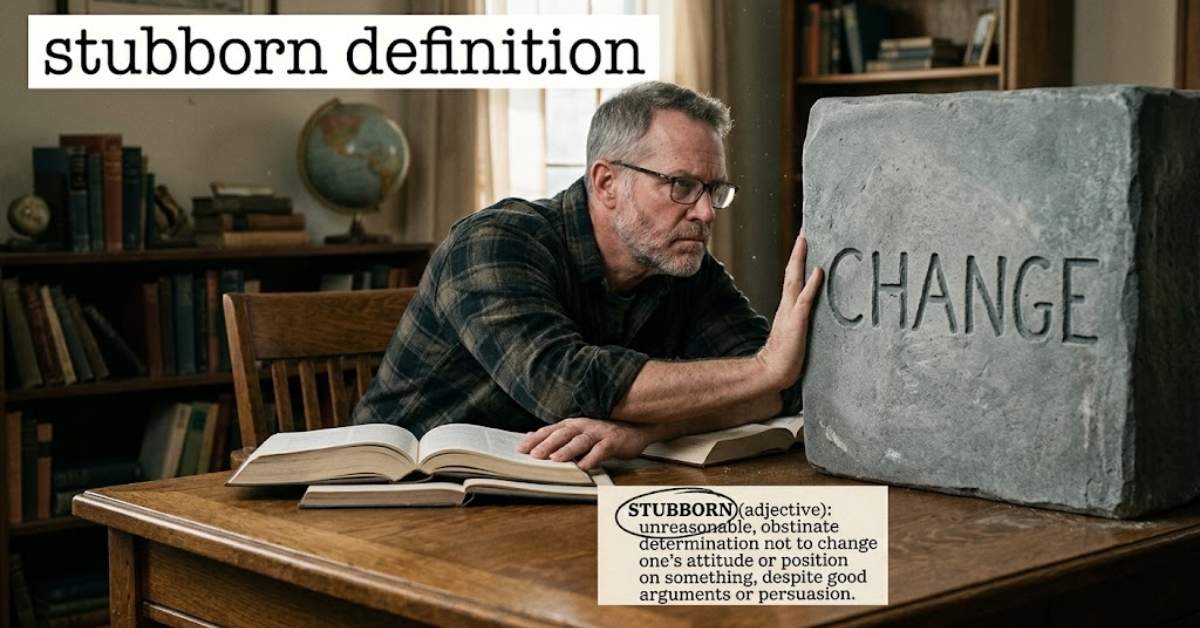
Stubborn means refusing to change your mind or course, even when others push back. It blends strong will, pride, and a bit of fear, and it shows up in every life.Ever wonder why your dad won’t ask for directions? Or why you can’t say sorry first, even when you know you should?
This guide unpacks the meaning of stubborn, the psychology of stubbornness, and how it shapes human behavior. Grab a coffee, and tell me in the comments which type sounds like you.
Definition & Core Meaning
Think of the word as a locked door.
Some doors guard what matters, and others just stay shut out of habit.
The definition of stubborn sits somewhere between loyalty and resistance.
Context decides which side wins.
Core Meanings of Stubborn
At its heart, a stubborn person is hard to convince.
They keep holding firm beliefs and often end up refusing to budge.
You’ll also hear it linked to resistance to influence and refusing to change.
Dictionaries stay neutral, but daily life rarely does.
Simple Examples
Picture a toddler clamping her mouth shut at broccoli time.
That’s stubborn behavior in its purest form.
Now picture an adult who won’t update his old phone, though it crashes daily.
Same stubborn attitude, just wearing grown-up clothes.
Historical & Cultural Background
Stubbornness didn’t start with modern life.
People have praised it and punished it for thousands of years.
Every society needed both rebels and rule keepers.
So the word picked up very different flavors along the way.
Ancient Meanings
Early texts often described stubborn people as hard-necked, like an ox that won’t pull.
The image stuck because farming communities needed cooperation.
Greek philosophers saw it differently.
Standing firm in your reasoning counted as conviction, not a flaw.
Religious & Moral Interpretations
Many faiths warn against a hardened heart.
There, stubbornness often reads as pride that blocks humility.
Yet the same traditions celebrate faith and perseverance.
The spiritual meaning shifts depending on what you hold onto.
Cultural Interpretations
Every culture sets its own comfort level with saying no.
What looks rude in one place can look respectful in another.
That’s why cultural meaning matters when you judge someone’s stubborn personality.
Here’s a quick tour.
Western Cultures
Western societies tend to prize independence and individuality.
Standing your ground often earns admiration.
Still, a boss who never listens gets labeled stubborn fast.
The line depends on who benefits.
Asian Cultures
Many Asian cultures value social harmony and family values.
Open defiance can feel disruptive there.
Quiet persistence, though, often earns respect.
A person may nod politely and still hold their position firmly.
Indigenous Perspectives
Many Indigenous communities link firmness to survival and traditions.
Holding onto land, language, and customs took real courage.
So stubbornness can mean protecting identity against hardship.
It’s less about ego and more about continuity.
Middle Eastern Traditions
In Middle Eastern traditions, honor and hospitality carry heavy weight.
Refusing to back down can protect family reputation.
Yet elders also prize wisdom and compromise.
Knowing when to yield counts as strength there.
Emotional & Psychological Meaning
Let’s go beneath the surface.
Behind most stubborn moments sits a feeling, not a fact.
The emotional meaning often involves worry about losing control.
The psychological meaning points to how we guard our sense of self.
Personal Growth
Strong will can fuel personal growth.
It keeps you studying, training, and trying after bad days.
But the same trait can freeze you in place.
Growth needs self-awareness, so you can tell grit from rigidity.
Identity & Self-Protection
For many, stubbornness works like emotional armor.
If you never give in, nobody can hurt your personal identity.
Underneath, you’ll often find fear of vulnerability and ego protection.
These defense mechanisms feel safe, but they build walls.
Healing, Mindset & Symbolism
Healthy firmness can show inner strength and emotional endurance.
Someone recovering from loss may refuse to quit on life.
Symbolically, stubbornness looks like a stone in a river.
It stays put while water, and time, flow around it.
Different Contexts & Use Cases
The word changes shape with the setting.
Here’s how it plays out in four common spots.
Personal Life
At home, stubbornness shows up in small fights.
Who loads the dishwasher right? Who drives?
These strong opinions feel tiny but pile up.
Spotting the pattern is step one.
Social Media
Online, people dig in harder.
An audience makes backing down feel like losing in public.
You’ll see stubborn memes and internet slang celebrating the trait.
That viral behavior makes digging in look fun, even when it isn’t.
Relationships
Partners often clash over apology refusal and silent standoffs.
Neither wants to be first to bend.
That creates emotional distance fast.
Small gestures can melt it quicker than debates.
Professional or Modern Usage
At work, workplace behavior gets judged by results.
A teammate defending a smart plan looks committed.
The same teammate ignoring data looks rigid.
Feedback resistance is usually the giveaway.
Hidden, Sensitive, or Misunderstood Meanings
Not every stubborn act is what it seems.
Sometimes the label hides a different story.
Calling someone stubborn can sting.
Understanding the reason behind it works better.
What People Get Wrong
Many assume stubborn means unintelligent or selfish.
Often it’s the opposite: someone cares deeply and fears losing it.
Others think it’s a fixed flaw.
In reality, stubborn behavior often shifts with stress and safety.
Cultural Misinterpretations
Directness can look stubborn in cultures that prefer hints.
A polite refusal can look stubborn elsewhere.
Misreading these signals leads to communication problems.
Ask before you assume.
When Meaning Changes
Same behavior, different meaning.
Here’s how the lens shifts.
In Psychology
Therapists treat emotional rigidity as a pattern with causes, not a character verdict.
Anxiety and emotional wounds often sit underneath.
That’s the heart of personality psychology here.
Behavior is a signal, so read it.
In Leadership
A leader who holds a vision through doubt shows leadership qualities.
A leader who rejects every challenge breeds silence.
Good leadership psychology blends conviction with listening.
Teams follow people who can adjust.
In Relationships
Standing firm on emotional boundaries protects you.
Standing firm on every petty point drains love.
Healthy couples use compromise where it counts.
They keep boundaries where it matters.
In Parenting
Child stubbornness often signals growing childhood independence.
A toddler saying “no” is practicing selfhood.
Parents can respond with choices, not battles.
That’s good parenting psychology, and it saves everyone’s evenings.
Comparison Section
Many words sound alike but mean different things.
This table shows the gaps at a glance.
| Trait | What it looks like | Key difference |
| Stubborn | Refuses to change, even with proof | Closed to new input |
| Determined | Pursues a goal with focus | Open to better routes |
| Persistent | Keeps trying despite setbacks | Adjusts the method |
| Rigid | Sticks to rules or habits | Fear of change |
| Strong-willed | Acts on own judgment | Still listens |
| Defensive | Protects ego from criticism | Reacts to feeling attacked |
Key Insight:
Determination vs stubbornness comes down to flexibility.
Determined people change tactics, while stubborn people change nothing.
The same logic covers persistence vs stubbornness and confidence vs stubbornness.
Ask yourself: would I listen if the facts changed?
Popular Types / Variations of Stubbornness
Stubbornness isn’t one flavor.
Here are ten styles you’ve likely met.
1. Emotional Stubbornness
You feel hurt and refuse to soften.
This is classic emotional resistance.
2. Intellectual Stubbornness
You defend an idea even after better evidence arrives.
It’s rigid thinking dressed as logic.
3. Positive Stubbornness
You keep going on a worthy goal.
This is healthy stubbornness, and it builds mental toughness.
4. Negative Stubbornness
You block change that would help you.
This unhealthy stubbornness costs time, money, and trust.
5. Defensive Stubbornness
You dig in the moment someone critiques you.
Defensive behavior protects pride, not progress.
6. Silent Stubbornness
No yelling, just quiet refusal.
It hides in the cold shoulder and the unanswered text.
7. Competitive Stubbornness
You can’t let a rival win, even in trivial matters.
Athletes and stubbornness often share this trait, for better and worse.
8. Cultural Stubbornness
A group clings to a tradition just because.
Sometimes it preserves heritage, and sometimes it blocks growth.
9. Relationship Stubbornness
Two people each wait for the other to cave.
Relationship stubbornness turns small issues into long cold wars.
10. Professional Stubbornness
You reject new tools or methods at work.
Professional stubbornness can sink project challenges fast, though it also fuels bold innovation when backed by facts.
How to Respond When Someone Asks About It
Someone says, “Are you stubborn?”
Your answer depends on the moment.
Here are four ways to play it.
Casual Responses
Keep it light with friends.
“Only when I’m right,” usually gets a laugh.
Or try, “Depends on the topic.”
It’s honest and keeps things easy.
Meaningful Responses
When it matters, be real.
“I hold firm on values, but I’m working on flexibility.”
That shows self-awareness.
People trust that honesty.
Fun Responses
Humor disarms tension.
“I’m not stubborn, I’m just early to my opinions.”
Or, “Persistent with attitude.”
Use these only when the mood fits.
Private Responses
Sometimes the question is for you.
Ask yourself why you’re holding on.
Write the answer down.
The reason, not the refusal, is what you need to see.
Regional & Cultural Differences
Attitudes toward saying no change across the map.
These are patterns, not rules, so treat them gently.
Western Cultures
Directness is common.
Authority and independence often clash openly.
People may debate hard and still stay friends.
Stubbornness gets called out quickly.
Asian Cultures
Emotional control and respect for elders guide behavior.
Open conflict is often avoided.
So firmness can look quiet and patient.
It may appear as steady, unspoken resistance.
Middle Eastern Cultures
Honor and loyalty shape how people argue.
Backing down in public can feel costly.
Private compromise, however, is common.
Respect works better than pressure.
African & Latin Cultures
African cultures and Latin cultures often weigh community and family heavily.
Strong emotional expression is accepted, even welcomed.
Passionate disagreement doesn’t always mean disrespect.
It often signals care.
How to Deal With a Stubborn Person
You can’t force anyone to change.
You can make change feel safer, though.
Try these moves:
- Listen first. People soften when they feel heard.
- Ask questions. “What worries you about this?” opens doors.
- Offer choices. Two options beat one order.
- Pick your battles. Save energy for what truly matters.
- Give time. Quick wins rarely come from pressure.
Practice patience and use plain words.
Good communication skills and emotional intelligence do most of the work.
How to Loosen Your Own Stubborn Streak
Spotting it in yourself takes courage.
Start by noticing the heat in your chest when someone disagrees.
Then try a few habits:
- Pause for ten seconds before replying.
- Ask, “What if they’re partly right?”
- Practice saying, “Let me think about that.”
- Review your personal values to separate principle from pride.
Real change takes practice.
Overcoming stubbornness builds adaptability skills and a growth mindset.
Conclusion
Stubbornness isn’t good or bad on its own. Its value depends on what you protect and how you hold it.Keep the inner strength, persistence, and resilience. Let go of the rigid thinking and emotional armor that hold you back.
What’s your stubborn story? Share it below, and pass this along to someone who needs a smile.
FAQs
What is the simple meaning of stubborn?
Stubborn means unwilling to change your mind or behavior. It describes someone who is hard to convince.Think of it as strong will with the door closed Open the door, and it becomes determination.
Is stubbornness always bad?
No, not at all. Positive stubbornness helps people finish hard goals and stay true to values.It turns harmfulwhen it blocks listening. Balanced stubbornness is the sweet spot.
What causes stubborn behavior?
Common roots include fear, pride, insecurity, and control issues. Past hurt and strict upbringing can add fuel.Stress also makes people dig in harder. Safetyusually helps them loosen up.
What is the difference between stubborn and determined?
Determined people stay open to better paths. Stubborn people ignore new information.Both push toward a goal. Only one adjusts along the way.
Can stubbornness affect relationships?
Yes, quite a lot. Relationship conflicts grow when nobody apologizes or compromises.Yet firm boundaries also protect healthy love. Balance is the secret.
Is stubbornness a personality trait?
Partly, yes. Many personality traits include a tendency to hold firm.But situations shape it too. So it’s a trait and a habit at once.
Can stubborn people change?
Absolutely. With self-awareness and practice, anyone can build flexibility.Change works best when it feels safe and chosen. Small steps beat big speeches.
