

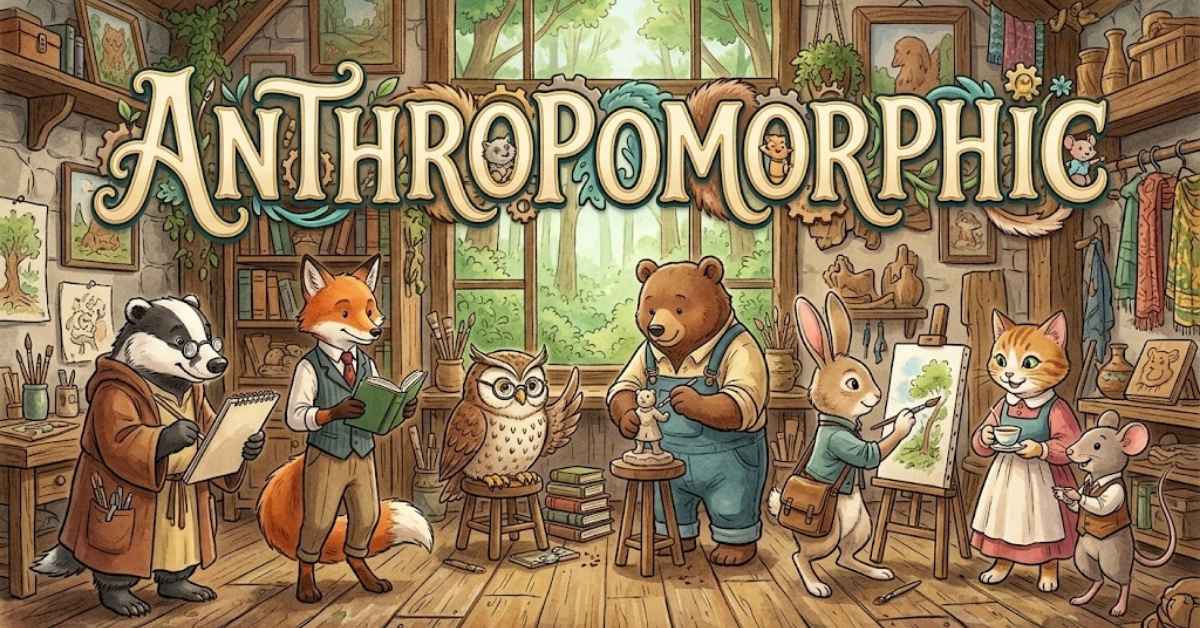
Ever yelled at a laptop because it “refuses” to start? Or told your cat she’s being dramatic? You’re not strange. You’re doing something people have done for thousands of years.The anthropomorphic meaning is simple. It describes giving human characteristics, like feelings, thoughts, and intentions, to non-human entities such as animals, objects, nature, or ideas. Anthropomorphism is the name for that habit.
In this guide, you’ll see where it came from, how it works, and why it shows up in stories, gods, brands, and AI. Grab a coffee. We’ll keep it easy.
Definition & Core Meaning
Think of anthropomorphic as a shortcut your brain loves. You see something that isn’t human, and you explain it with human traits. It feels natural, so you rarely notice it.
This habit shapes how we talk, joke, worship, shop, and even how we treat machines. Let’s break it down piece by piece.
Core Meanings of Anthropomorphic
The definition of anthropomorphic is “having human form or human qualities.” The simple meaning of anthropomorphic is treating a non-human thing like a person.
As an adjective, anthropomorphic describes the thing itself, like a rabbit who wears glasses and runs late. As a noun, anthropomorphism describes the act of seeing it that way.
Key Characteristics
Look for three signs. The subject isn’t human, it shows human emotions or human intentions, and the audience accepts it without much fuss.
Many examples also show human-like reasoning, speech, or agency and decision-making. A stubborn donkey in a cartoon checks every box.
Common Applications
You’ll spot this idea in storytelling, religion, psychology, advertising, and software. Writers use it to teach. Brands use it to bond. Scientists sometimes use it to explain complex systems.
It also lives in everyday speech. When you say “the printer hates me,” you’re using anthropomorphic language without any special training.
Simple Examples
Here are quick anthropomorphic examples you already know:
- Talking to your dog like a roommate
- Naming your car “Bertha”
- Saying a stubborn coffee machine woke up grumpy
- Blaming an angry storm for ruining your picnic
Each one gives a thing human behavior it doesn’t literally have. That’s the whole trick.
Anthropomorphism vs. Personification
People mix these up all the time. Personification is a literary device, a deliberate bit of figurative language, like “the wind whispered.” Anthropomorphism goes further.
In anthropomorphism, the subject often acts like a person for real inside the story, with a name, a voice, and choices. We’ll compare them in a table later.
Historical & Cultural Background
The origin of anthropomorphic is Greek. The word blends anthrōpos (human) and morphē (form), so it literally means “human-shaped.” Not exactly a mystery.
The habit is much older than the word. Early people needed to explain thunder, hunger, and luck, so they gave the world a personality.
Ancient Context
In ancient civilizations, nature spirits and gods filled the gaps science couldn’t. Rivers got moods. Seasons got stories. The unknown felt friendlier when it had a face.
Greek thinker Xenophanes even poked fun at this. He argued that if horses could draw, their gods would look like horses. Pretty sharp for 2,500 years ago.
Cultural Interpretations
Different cultures used the idea for different jobs. Some told animal fables to pass on moral lessons. Others honored animals and forests as living relatives.
That’s why folklore and traditional storytelling feel so varied. The tool stays the same, but each culture shapes it to match its values.
Why Our Brains Do This
Your brain is a pattern hunter. When something moves with purpose, you assume someone is behind it. That instinct kept our ancestors alive.
A famous 1944 study by Heider and Simmel showed this clearly. People watched simple moving shapes and described bullies, heroes, and chases. Just triangles, and yet everyone saw a plot.
Emotional & Psychological Meaning
Psychological anthropomorphism is about connection. Humans crave company, so we find it in pets, plants, and gadgets. It isn’t silly. It’s how human psychology handles loneliness and uncertainty.
It also helps with emotional understanding. If a thing has feelings, you can predict it, relate to it, and care about it.
Identity & Connection
When you name your guitar or say your old bike “knows the way,” you build emotional connection. Objects soak up sentimental value, and the bond feels real.
This is also emotional projection. You put your own feelings onto something outside you, then read them back. It’s a gentle mirror for identity.
Healing & Mindset
Giving a worry a face can make it smaller. Some people talk to their anxiety like a nervous friend, which helps with processing emotions and feeling less alone.
It’s also big in child development. Kids use imagination and empathy to practice kindness through toys, teddy bears, and talking animals.
Different Contexts & Use Cases
Where does this habit show up in real life? Almost everywhere. Here’s a quick tour of the places you’re most likely to meet it.
Personal Life
At home, it’s talking to pets, naming devices, and scolding a laptop refusing to work. You might say your plant is judging you for forgetting water.
It’s harmless most of the time. It also makes chores and tech troubles feel a little lighter.
Social Media
Memes run on this. A sleepy raccoon “feels” exactly how you do on Monday. Online engagement jumps when people see themselves in a relatable character.
Brands and creators know it. A pet account that “writes” captions gets more shares than a plain photo.
Relationships
In relationships, we sometimes assign intention where none exists. “The traffic did that on purpose” is a mild case. “My phone ignores me” is another.
Spotting this helps you pause before blaming a person or a thing. Not every silence is a message.
Professional or Modern Usage
Teachers use it to explain science. Designers use it to make products friendlier. Writers use it to make abstract ideas like justice or time feel close.
In business, it supports customer engagement and clear educational explanations. Used well, it turns dry facts into something people remember.
Hidden, Sensitive, or Misunderstood Meanings
Not everything about this habit is cute. It can blur facts, mislead audiences, and even shape moral judgment. Let’s clear up a few things.
Common Misunderstandings
Many people think anthropomorphism is childish. It isn’t. Adults do it constantly, and professionals use it on purpose.
Another myth is that it’s just metaphor. Sometimes yes, but often it describes real behavior inside a story or a belief system. Context decides literal versus symbolic meaning.
What People Miss
Here’s what gets overlooked. It’s a cognitive bias as well as a cognitive tool. It helps us understand, but it can also mislead when we assume human-like consciousness that isn’t there.
In science, uncontrolled anthropomorphism can skew research. A scientist who says a bird “feels jealous” might overlook simpler explanations.
Comparison Section
Related terms sound alike, so a side-by-side view helps. Here’s the quick version.
| Term | What it means | Quick example |
| Anthropomorphism | Giving human traits to non-human things | A talking mouse in a hat |
| Personification | A figure of speech using human qualities | “The sun smiled” |
| Metaphor | A comparison without “like” or “as” | “Time is a thief” |
| Zoomorphic | Giving animal traits to humans or gods | A god with a hawk’s head |
| Anthropocentric | Seeing humans as the center of everything | “Nature exists for us” |
| Animism | Belief that things have spirits | A sacred mountain with a soul |
The big difference between anthropomorphic vs. personification is depth. One is a passing image, the other often builds a whole character.
Popular Types & Variations of Anthropomorphic
There are many flavors of this idea. Here are nine you’ll meet again and again.
1. Literary Anthropomorphism
This is the talking animals in stories kind. Think Animal Farm by George Orwell, where pigs run a farm and carry political messages.
Winnie the Pooh and the animal fables of old work the same way. The animals carry social messages without lecturing.
2. Psychological Anthropomorphism
Here the action happens in your head. You feel a doll is “sad” or a house is “welcoming.” It’s emotional projection onto objects, driven by human perception.
It’s quiet and personal. You rarely announce it, but it guides many choices.
3. Religious Anthropomorphism
Many faiths describe the divine in human terms, like a god who sees, speaks, or feels anger. It makes divine concepts easier to grasp.
In Greek mythology, Zeus and Hera even argue like a couple. Their human flaws in deities made the myths relatable.
4. Cultural Anthropomorphism
Nations, cities, and teams often get human faces. Uncle Sam, Lady Liberty, and sports mascots show how human traits assigned to nations build pride.
It’s a symbolic expression of shared identity. People rally around a figure far more easily than around an idea.
5. Marketing Anthropomorphism
Brands love friendly brand mascots. A smiling snack or a chatty insurance lizard builds brand personality and brand relatability.
This is anthropomorphic branding at work. Customers feel a bond, and emotional branding does the rest.
6. Technological Anthropomorphism
We name our robots and thank our smart assistants. Human-like voices and polite replies push us to see AI assistants as someone, not something.
It started early. In the 1960s, users of a simple chat program called ELIZA shared personal thoughts with it, even knowing it was code.
7. Childlike Anthropomorphism
Kids give objects feelings easily. A spoon can be sleepy, and a toy can be lonely. This is developmental imagination in action.
It’s healthy and useful. It teaches empathy long before kids can explain it.
8. Environmental Anthropomorphism
Here, nature as emotional takes the stage. We speak of an angry wind, a crying sky, or an earth that is healing.
It can inspire care for the planet. It can also hide how nature really works, so balance matters.
9. Moral Anthropomorphism
This type assigns intention or blame to forces and ideas. “Fate punished him” gives abstract ideas a will and a sense of justice.
It’s a way of making sense of luck, loss, and consequences. It’s also a good reminder to question our stories.
Anthropomorphism in Technology and AI
Modern human-machine interaction leans on this heavily. Voice assistants, chatbots, and humanized devices speak in friendly tones to feel less cold.
That’s useful, but there’s a catch. A smooth voice can suggest human-like awareness that a system doesn’t actually have, so clear expectations protect users.
How to Respond When Someone Asks About It
Say a friend asks, “What does anthropomorphic mean?” You don’t need a lecture. You need the right tone for the moment.
Casual Responses
Keep it light. “It’s when we treat non-human things like they’ve got human feelings, like calling your car moody.” Short, clear, done.
Add one example from their world, and it’ll stick.
Meaningful Responses
For deeper chats, explain the “why.” “We do it to understand and connect with things. It’s a cognitive tool that helps us feel less alone.”
This works well in class, at work, or in a thoughtful conversation.
Fun Responses
Play with it. “It’s why my coffee machine is a diva and my plant is a drama queen.” People smile, and they remember.
Humor makes a tricky word feel friendly.
Private Responses
If someone is sharing something personal, like talking to a lost loved one’s photo, stay gentle. Skip the lecture.
A simple “That sounds comforting” respects the emotional companionship they feel.
Regional & Cultural Differences
Every region puts its own spin on anthropomorphic storytelling. Here’s a snapshot, though no culture is one single thing.
Western Cultures
In the West, cartoon animals rule pop culture. Mickey Mouse and Disney turned human-like characters into global icons, and Winnie the Pooh became a comfort classic.
Fables and Animal Farm show a sharper side, using animals to talk about power.
Asian Cultures
Anime and games lean on humanized characters, from spirits in folklore to moe anthropomorphism, where objects or nations become cute characters.
Many traditions also see nature and spirituality as linked, so mountains and trees often carry personalities.
Middle Eastern Cultures
Here, animal fables and wisdom tales carry moral lessons. Stories of clever foxes and wise birds travel across borders and centuries.
Religious contexts are often careful about describing the divine in human terms, which shapes how the idea is used.
African & Latin Cultures
African folklore is rich with trickster animals like Anansi the spider. These tales teach, entertain, and keep cultural identity alive.
Latin traditions blend Indigenous cultures, folk art, and religion, giving living beings like animals and landscapes strong symbolic roles.
Is Anthropomorphism Good or Bad?
Honestly, both. It builds empathy, makes learning easier, and helps people connect. It can also lead to misleading human comparisons if we’re careless.
Use it as a tool, not as proof. Enjoy the story, but check the facts, especially with animals, science, and AI.
Conclusion
Anthropomorphism is simply how humans make sense of a big, confusing world. We lend human emotions and human intentions to things that can’t claim them, and it helps us feel connected.
Now you know the true meaning of anthropomorphic, its roots, its types, and its limits. Which example surprised you most? Drop your favorite in the comments, and share this with a friend who names their car.
FAQs
What does anthropomorphic mean?
It means giving human characteristics or form to something non-human, like an animal, object, or idea.
What is anthropomorphism in simple words?
It’s treating things that aren’t human as if they have human feelings, thoughts, or goals.
What is an example of anthropomorphism?
A talking mouse like Mickey Mouse, or saying your laptop “hates” you when it freezes.
Is anthropomorphism the same as personification?
Not quite. Personification is a figure of speech, while anthropomorphism often gives a subject real human behavior inside a story or belief.
Why do humans anthropomorphize objects?
We do it to understand things, predict them, and feel connected. It’s a built-in cognitive tool tied to empathy and imagination.
Is anthropomorphism scientifically accurate?
Often it isn’t. It’s useful for explaining ideas, but in research it can add cognitive bias, so scientists use it carefully.
What is the difference between anthropomorphic and anthropocentric?
Anthropomorphic gives human traits to non-human things. Anthropocentric puts humans at the center of everything.
