

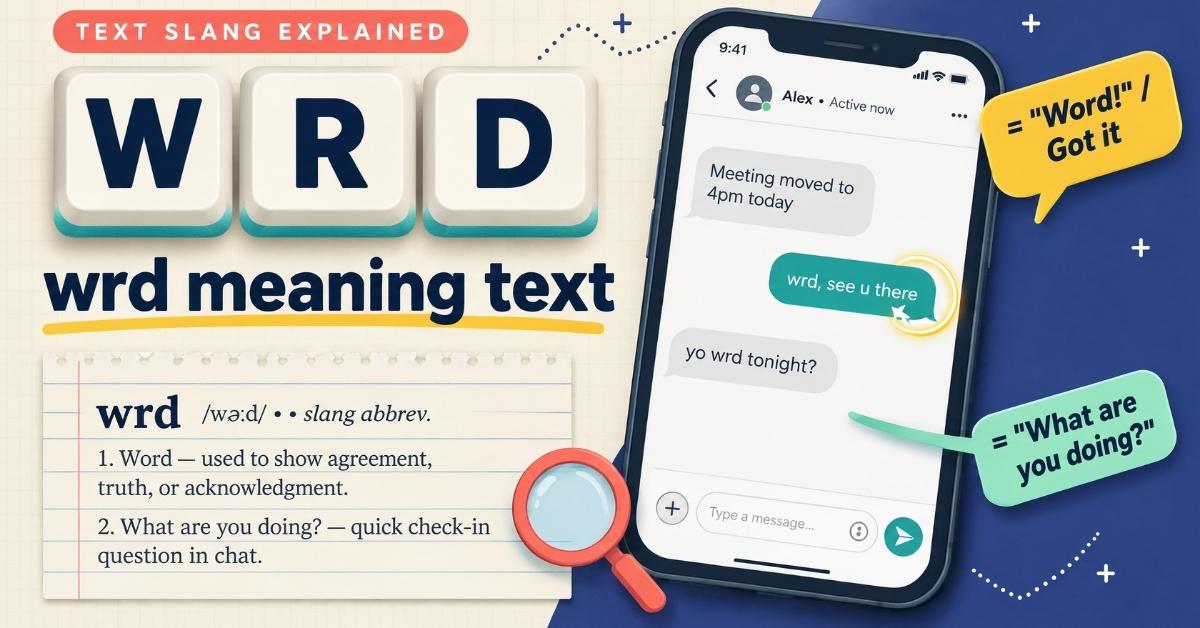
Someone texts you “wrd” and you freeze. Is it a typo? Is it slang? Are they agreeing with you or mocking you?Here’s the short answer. WRD is texting slang for “word.” In a chat, it means “I agree,” “true,” “I get it,” or “got it.” Context and tone decide the rest.
You’ll see it most in casual conversation between friends, classmates, and young adults. It’s quick, relaxed, and a little cool. This guide breaks down where it came from, how to read it, and how to reply.
Meaning & Definition
WRD is a text abbreviation for the word “word,” used as a reaction word. It works like a thumbs up in text message form. Someone says something, and you answer “wrd” to show you’re on board.
It carries a few shades of meaning. It can signal agreement, confirmation, understanding, or plain acknowledgment. Sometimes it shows surprise or curiosity too, depending on punctuation.
Think of it as shorthand for a nod. You don’t need a full sentence when two letters missing from “word” can say the same thing. That’s why fast replies love it.
What Does WRD Meaning in Text?
Most people searching this phrase want one thing: what does WRD mean when it lands in my inbox? In nearly every online chat, it means “I hear you and I agree.” It’s a friendly quick response.
Picture a friend saying, “Pizza at 8?” You answer “wrd.” You just said yes, I’m in, and I’m not typing more. No awkward pause, no long reply.
Tone matters, though. A flat “wrd” can feel casual. A “wrd!!” feels excited. A “wrd?” asks for proof, as in “Is that really true?”
Quick Example:
Maya: The game got moved to Friday. Jordan: wrd, I’ll tell the team.
Jordan did three jobs with one word. He confirmed the news, showed understanding, and moved the plan forward. That’s chat response efficiency at its best.
Background / Origin
The root is the word “word,” and its slang life started long before smartphones. It grew out of urban slang and hip-hop culture, especially from African American communities. Phrases like “word up” and “word is bond” carried the same idea: I’m telling the truth, and I agree with you.
By the 1980s and 1990s, “word” was common in music and street talk. Then early internet slang picked it up on forums, instant messengers, and online communities. Typing “wrd” saved a few keystrokes on T9 keypads.
Today it keeps moving through youth culture and internet culture. Teenagers pass it along on TikTok and Snapchat, and memes keep it in circulation. This is classic evolving language, where spoken slang becomes digital slang.
Usage in Different Contexts
Slang never stays in one place. The same two letters can feel different in a group chat, a direct message (DM), or a comment under a post. Your audience shapes how it lands.
Among friends and family members, it reads as warm and relaxed. With coworkers, it depends on your office culture. Strangers online may not know it at all.
Here’s a simple rule I use. If you’d say “word” out loud to that person, texting “wrd” is fine. If you’d never say it, skip it.
General Usage
In everyday texting, WRD usually shows up in short bursts. It answers a plan, a confirmation, or a piece of news. It rarely starts a conversation.
You’ll often see it paired with other text lingo. “Wrd, bet” means “agreed, let’s do it.” “Wrd fr” leans on FR (For Real) for extra emphasis.
Here are common ways people use it:
- Agreement: “We should leave early.” / “wrd.”
- Confirmation: “Meet at the library?” / “wrd.”
- Understanding: “Class is moved to room 4.” / “wrd, thanks.”
- Reaction to news: “I got the job.” / “wrd!! congrats.”
Formal vs Informal Usage
WRD lives in informal language. It fits casual chats, quick online messaging, and relaxed social interaction. It doesn’t belong in formal communication.
Skip it in business emails, academic writing, and official reports. Those spaces reward clarity and professionalism. A manager reading “wrd” might wonder if you’re brushing them off.
For workplace communication, swap it with “Understood,” “Sounds good,” or “Thank you for informing me.” If your team Slack is loose and playful, a light “wrd” can work. When in doubt, mirror how your boss writes.
WRD Meaning on Social Media Platforms
Every app has its own flavor, and social media slang bends to fit. WRD stays friendly across most of them. Still, small differences exist.
WRD meaning on Snapchat is simple: it’s a quick agreement in a chat or a story reply. It’s perfect for streak conversations, where people want to keep the thread alive without much effort. A one-word reply does the job.
On WhatsApp, it appears in group chats and personal threads as a fast acknowledgment. On Instagram, you’ll spot it in DMs and comments under posts. On TikTok, it pops up in captions and social media comments, often next to relatable videos where viewers want to say “so true.”
Other Meanings in Different Fields
Not every WRD is slang. Some context-dependent meaning shows up in work settings. A custom abbreviation or internal abbreviation can borrow those same three letters.
For example, teams may use WRD as a file reference or project name. In technology abbreviation lists or software discussions, it can stand for a module or draft label. Some healthcare departments may also shorten a ward name in notes, though practices differ by hospital.
Even physics abbreviation lists or niche glossaries might feature it. There’s no universal standard here. If the setting is professional and the term sits next to technical words, ask what it means before you guess.
Examples of WRD Meaning in Text in Sentences
Seeing slang in action beats reading definitions. Here are texting examples and sentence examples you can borrow. Notice how context and tone change the feel.
- “Study group at 6 tonight?” / “wrd, I’m bringing snacks.”
- “I’m not coming to the party.” / “wrd? why not?”
- “The new album drops at midnight.” / “wrd, I’m staying up.”
- “That test was brutal.” / “wrd, I barely finished.”
- “I finished the project early.” / “wrd, nice work.”
Each reply stays short and natural. That’s the whole point of everyday texting. One word, clear feeling, done.
Common Misconceptions
People get a few things wrong about WRD, and the confusion is understandable. Slang moves faster than dictionaries. These common misconceptions come up again and again.
Myth 1: WRD always means “really.” Not quite. “Wrd?” with a question mark can sound like “Really?” but the word itself means agreement.
Myth 2: It’s rude. Usually it isn’t. It’s a conversational tone choice, and most people use it kindly.
Myth 3: Only teens use it. Younger folks lead the way, but young adults and even older social media users use it too.
Myth 4: It has one fixed meaning everywhere. Like most internet vocabulary, it shifts with the group, the platform, and the person typing.
Similar Terms & Alternatives
WRD has plenty of cousins in the slang dictionary. If you want a different flavor, you have lots of options. Each carries its own tone.
- Facts: “That’s true.” Strong, confident agreement.
- True: A simple nod to something accurate.
- Exactly: Warm agreement with extra emphasis.
- Bet: “Okay, deal.” Often used for plans.
- Say less: “I get it, no need to explain more.”
- No cap: “No lie.” Adds honesty to a statement.
- FR (For Real): Genuine agreement or surprise.
- Seriously / Really: Used to question or confirm.
- Congrats: A plain, kind reaction to good news.
Mixing these keeps your conversation fresh. Nobody wants to sound like a broken record. Rotate your alternative slang based on mood.
How to Respond to WRD Meaning in Text When Someone Uses It
Replying to WRD is easy, because it’s usually a closing note. You don’t always need to answer at all. If the topic is settled, a reaction emoji works.
When you do want to keep chatting, try one of these:
- “Cool, see you then.”
- “Thanks, talk soon.”
- “Great, I’ll send details later.”
- A thumbs up or smiley for message reaction.
If you’re unsure what they meant, ask. A simple “wrd as in you agree?” clears things up fast. Good texting etiquette values clarity over pretending to know.
Difference Between WRD Meaning in Text and Similar Terms
The gaps between slang terms are small but real. Here’s a quick slang comparison to help you choose.
| Term | Main feel | Best used for |
| WRD | Casual agreement | Confirming plans, quick replies |
| Facts | Strong truth | Agreeing with a strong opinion |
| Bet | Deal made | Accepting an invitation |
| No cap | Honesty | Stressing you’re not lying |
| FR | Real emotion | Agreement or shock |
| Say less | Full understanding | Cutting a long explanation short |
So WRD sits in the middle. It’s lighter than “facts” and softer than “bet.” Think of it as the easygoing choice.
Relevance in Online Conversations & Dating Apps
On dating apps, WRD can read as relaxed and confident. You might use it to agree on a plan, like a coffee date on Saturday. It signals you’re easy to talk to.
Be careful, though. Too many short replies can feel low-effort. If your match writes a thoughtful message, answer with more than “wrd.”
In gaming communities, it fits perfectly during fast online conversations. Players use it to confirm a strategy mid-match. The same applies across messaging platforms where speed beats polish.
Why WRD Keeps Surviving Online
Slang usually fades in a few months. WRD sticks around because it solves a real problem. It’s short, friendly, and carries a clear meaning for people in the loop.
It also builds belonging. When classmates or online communities share a word, they feel closer. That’s a quiet strength of texting culture and modern communication.
Expect it to keep changing. Language is alive, and internet trends will reshape how people say “I agree.” Good communication skills include staying curious about those shifts.
Quick Tips for Using WRD Without Sounding Awkward
First, match your audience. Use it with people who already speak that way. Forcing slang on a stranger can backfire.
Second, watch your punctuation. A period can make it sound flat, while an exclamation mark adds energy. A question mark invites a follow up.
Third, don’t overdo it. One “wrd” in a chat feels natural. Ten in a row feels like a chat response on autopilot.
Conclusion
WRD is a tiny abbreviation with a clear job. It means “word,” and in most online chats it signals agreement, understanding, or confirmation. Read the context, check the tone, and you’ll rarely get it wrong.Use it with friends and in casual digital communication. Keep it out of professional communication and formal writing. That simple rule keeps you safe.
Now it’s your turn. Have you seen WRD used in a way that surprised you? Drop your story in the comments, share this guide with a friend who keeps asking, and tell us which slang you want decoded next.
FAQs
What does WRD mean in texting?
In texting, WRD means “word,” used to show agreement, understanding, or confirmation. It’s the same as saying “I agree,” “got it,” or “true.” Use it in casual messaging with people you know well.
Is WRD a positive response?
Yes, usually. It signals you’re on board with what someone said. Only a question mark or a sarcastic tone changes that.
What does WRD mean on Snapchat?
On Snapchat, WRD is a fast reply in chats or story replies. It shows you agree or you saw the message. It helps keep streak conversations going.
Is WRD formal slang?
No. WRD is informal language and belongs in casual conversation. For emails, reports, and school work, choose clear phrases like “Understood” or “I agree.”
Can WRD mean “really”?
Not by itself. WRD means “word,” but “wrd?” with a question mark can work like “Really?” It then shows surprise or curiosity. Tone and context make the difference.
Who uses WRD the most?
Teenagers and young adults use it the most, especially on Snapchat, TikTok, and WhatsApp. Still, friends and family members of all ages pick it up. It spreads wherever relaxed chat happens.
