

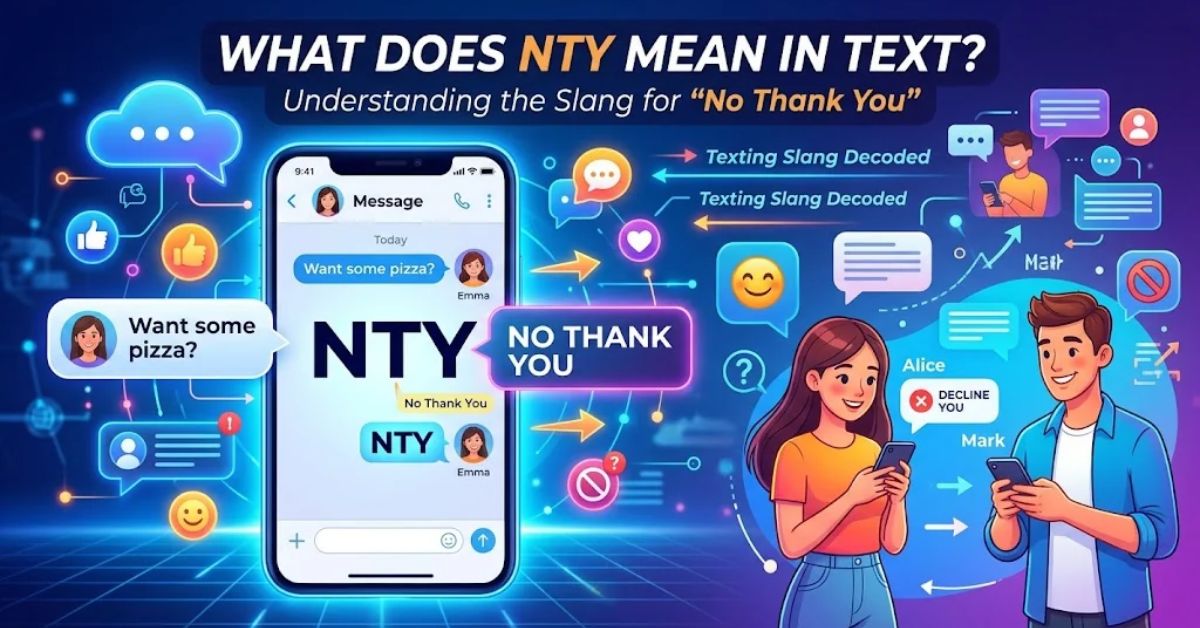
Ever received a text saying NTY and wondered whether it was friendly or a little rude? You’re not alone! Online chats are full of short forms that can leave you scratching your head. NTY stands for No Thank You. People use it to turn down offers, invitations, or suggestions without typing a long reply. It’s a quick way to say no while keeping things simple.
You might spot NTY in WhatsApp messages, Instagram DMs, Snapchat chats, or TikTok comments. But here’s the interesting part: its tone isn’t always the same. Depending on the conversation, it can sound polite, casual, cold, or dismissive. Understanding this popular texting abbreviation helps you avoid confusion and respond with confidence. Let’s break down its meaning, origin, common uses, and real-life examples.
Meaning & Definition
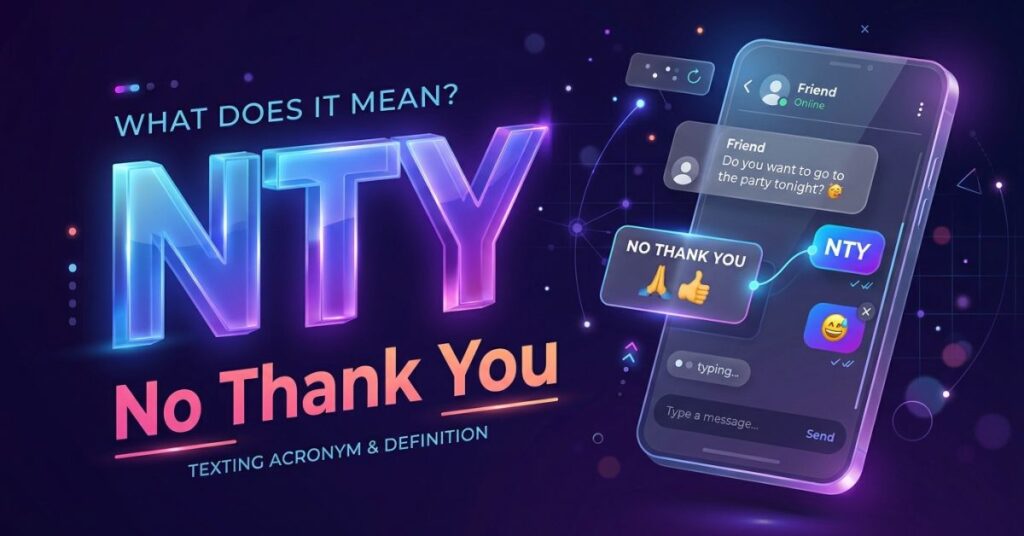
The NTY meaning in text is No Thank You. People use this short form when they want to politely refuse something. It offers a quick way to say no without sounding too harsh or unfriendly.
NTY belongs to modern texting language and internet slang. Friends, classmates, and online users often use it during casual conversations. Instead of typing a complete sentence, they use this simple abbreviation to save time.
You might see NTY when someone offers food, suggests shopping, or invites you somewhere. It usually shows politeness while making your decision clear.
For example:
- Someone offers you pizza, and you reply, NTY, I’m full.
- A friend invites you gaming, and you respond, NTY, maybe tomorrow.
- Someone offers coffee, and you say, NTY, thanks!
In simple words, NTY is a texting shortcut that helps you decline an offer while maintaining a friendly tone.
What Does NTY Meaning in Text?
If you’re wondering what does nty mean in text, it stands for No Thank You. It’s a common abbreviation used in online chats and informal digital communication.
People usually type NTY when they don’t want something. It can also help them decline an invitation without writing a lengthy response.
For example, imagine your friend asks whether you want to join a shopping trip. You already have other plans, so you reply:
Friend: Want to go shopping this afternoon?
You: NTY, I have some work to finish.
This response communicates your decision without creating unnecessary confusion.
Here are a few things to remember:
- NTY full form: No Thank You.
- Main purpose: Politely say no.
- Common setting: Casual conversations and messaging apps.
- Tone: Usually friendly, respectful, or neutral.
- Usage: Informal texting and social media.
However, the meaning can depend on the conversation. A short NTY might sound cold if someone expects a warmer explanation. Adding thanks or an emoji can make your reply friendlier.
Background / Origin
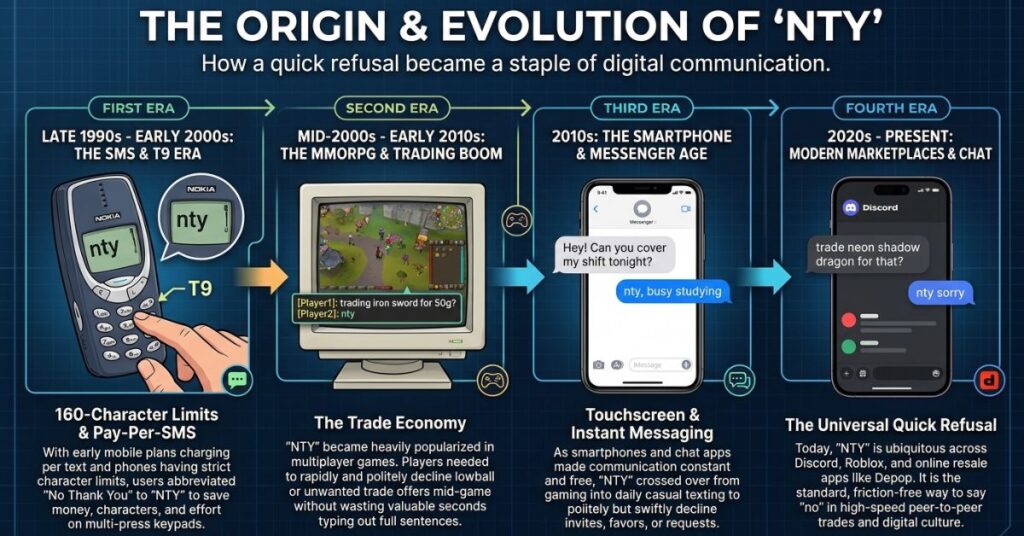
The background and origin of NTY connect to the evolution of internet slang. As digital communication became more common, people started shortening everyday phrases.
During the mobile texting era, SMS texting encouraged users to write shorter messages. Small keyboards and limited message lengths made texting shortcuts especially useful.
Over time, abbreviations became popular across messaging apps and online communities. People started using short forms to communicate quickly without typing complete sentences.
NTY developed from the familiar phrase No Thank You. It follows the same pattern as other texting abbreviations that shorten common expressions.
Today, you may encounter NTY in:
- Private messages between friends.
- WhatsApp and Instagram DMs.
- Snapchat conversations.
- TikTok comments and social media discussions.
- Online gaming chats and communities.
Although people still use NTY, many prefer typing the complete phrase. Both options communicate the same basic message.
Usage in Different Contexts
NTY works in several everyday situations where you need to refuse something. It helps you communicate your decision without making the conversation unnecessarily complicated.
People commonly use this abbreviation when declining offers, invitations, suggestions, or requests. Its meaning stays similar, but the tone can change depending on your relationship.
For example, you might use NTY with friends when refusing coffee. You could also send it to someone offering a gaming invitation.
Common situations include:
- Food offers: NTY, I already ate.
- Shopping plans: NTY, I’m saving money.
- Gaming invitations: NTY, maybe next time.
- Social invitations: NTY, I have other plans.
- Unwanted suggestions: NTY, I’m not interested.
The main purpose is to politely say no while keeping communication efficient.
However, consider the person receiving your message. A complete sentence may work better when the situation requires extra respect or explanation.
General Usage
In general conversations, NTY is a quick way to decline something. Friends, classmates, and younger users often use it in casual messages.
Imagine someone offers you a slice of pizza. Instead of writing a long response, you can simply type NTY. It saves time while making your decision clear.
Here are some everyday uses:
- Food: NTY, I’m already full.
- Coffee: NTY, I don’t drink coffee.
- Gaming: NTY, I’m taking a break.
- Shopping: NTY, I’m saving money.
- Invitations: NTY, maybe next time.
You can also add emojis to make your message feel warmer.
For example:
Friend: Want to play games tonight?
You: NTY 😅 Maybe tomorrow!
This response sounds casual and friendly. It also keeps the conversation open for another time.
Formal vs Informal Usage
NTY is mainly suitable for informal communication. You can use it when chatting with friends, family members, or people you know well.
However, it isn’t the best choice for professional communication. Business emails, academic writing, and workplace messages usually require complete words and clear sentences.
Consider these differences:
| Informal usage | Formal alternative |
| NTY, thanks! | No thank you. |
| NTY, I’m busy. | Thank you, but I’m unavailable. |
| NTY, maybe later. | I appreciate the offer, but perhaps another time. |
| NTY, I’m good. | Thank you, but I must decline. |
In professional situations, politeness matters more than communication speed.
For example, if a colleague offers you an extra task, respond with a complete sentence. It sounds more thoughtful and respectful.
Save NTY for casual conversations where everyone understands texting abbreviations.
NTY Meaning on Social Media Platforms
NTY appears across different social media platforms and messaging apps. People use it to decline suggestions, offers, and invitations without typing lengthy responses.
Its meaning generally stays the same across platforms. However, the conversation style can influence how others interpret it.
Here’s how people commonly use NTY:
- WhatsApp: Friends use NTY when declining invitations, food offers, or suggestions in private chats.
- Instagram: You might see it in Instagram DMs when someone politely refuses an invitation or offer.
- Snapchat: Users send NTY as a quick response to messages or story replies.
- TikTok: NTY sometimes appears in TikTok comments when users reject suggestions or opinions.
- Facebook: People may use it in comments, Messenger conversations, and group discussions.
- Discord: Online users use NTY when declining gaming invitations or suggestions.
For example:
Friend: Want to join our Snapchat streak challenge?
You: NTY 😂 I’m already busy!
Remember that NTY is internet slang, not a special feature of any particular platform.
Other Meanings in Different Fields

Although NTY meaning in text usually refers to No Thank You, abbreviations can have different meanings in specialized fields.
In technical or professional settings, NTY might appear as an internal code, label, or organization-specific abbreviation. Its meaning depends on the subject and surrounding information.
Here are a few distinctions:
- Medical: NTY doesn’t have one widely recognized standard medical meaning. Always check the medical document’s context.
- Physics: NTY isn’t a commonly established physics abbreviation. Scientific symbols and abbreviations depend on the specific topic.
- Technology: NTY may appear in internal notes, databases, or informal technical chats. However, it doesn’t have one universal technical definition.
When you encounter NTY outside texting, don’t automatically assume it means No Thank You.
Check the surrounding words and subject first. Context helps you understand whether someone is using internet slang or a specialized abbreviation.
Examples of NTY Meaning in Text in Sentences
The easiest way to understand NTY is through real-life conversation examples. These sentences show how people use the abbreviation when refusing offers and invitations.
Whether you’re chatting with friends or responding in online communities, NTY keeps your replies short and simple.
1. Food Offer
Alex: Do you want some pizza?
Sam: NTY, I’m already full. 🍕
2. Coffee Invitation
Mia: Should I bring you coffee?
Lily: NTY, I already had two cups. ☕
3. Gaming Invitation
Jake: Are you joining our gaming session tonight?
Ryan: NTY, I’m too tired today. 🎮
4. Shopping Plans
Emma: Let’s go shopping this weekend!
Sophie: NTY, I’m saving money right now. 💸
5. Party Invitation
Chris: Are you coming to my birthday party?
Daniel: NTY, I have other plans. Maybe next time!
6. Movie Suggestion
Ava: Want to watch another movie?
Noah: NTY, I’m going to sleep. 😴
These sentence examples show how NTY works in different situations. You can also add words like thanks, sorry, or maybe later to make your refusal sound warmer.
Common Misconceptions
People sometimes misunderstand NTY because they don’t know how texting abbreviations work. Although NTY usually means No Thank You, its tone can change depending on the conversation.
Here are some common misconceptions worth clearing up:
- Misconception 1: NTY is always rude. Not true. It often expresses a polite refusal. However, it may sound cold without additional words.
- Misconception 2: NTY has several common texting meanings. Its most widely understood texting meaning is No Thank You.
- Misconception 3: NTY is suitable for professional emails. NTY is informal slang. Complete sentences work better in business communication.
- Misconception 4: NTY means someone dislikes you. It usually means someone doesn’t want a particular offer or invitation.
- Misconception 5: NTY and NVM mean the same thing. They have different meanings and serve different purposes.
For example:
Friend: Want to grab some coffee?
You: NTY, I’m good!
This response simply declines the offer. It doesn’t mean you dislike your friend.
Similar Terms & Alternatives
NTY belongs to a large group of texting abbreviations used in everyday digital communication. However, not every short form expresses the same feeling or message.
Some abbreviations communicate refusal, while others show uncertainty or appreciation.
Here are some similar terms and alternatives:
| Abbreviation | Full form | Meaning |
| NVM | Never Mind | Forget something or cancel a request |
| BRB | Be Right Back | Temporarily leaving a conversation |
| IDK | I Don’t Know | Expressing uncertainty |
| IMO | In My Opinion | Sharing a personal viewpoint |
| TBH | To Be Honest | Introducing an honest opinion |
| TY | Thank You | Showing appreciation |
| TYVM | Thank You Very Much | Expressing extra gratitude |
| NP | No Problem | Responding casually to thanks |
For example:
Friend: Do you want to join us tonight?
You: NTY, I’m staying home.
Friend: No problem!
Understanding these texting shortcuts helps you follow fast-paced chats. It also prevents confusion when different abbreviations appear together.
How to Respond to NTY Meaning in Text When Someone Uses It
Knowing what does nty mean in text also helps you respond appropriately. When someone sends NTY, they’re usually declining your offer or invitation.
The best response depends on your relationship and the situation. You don’t need to take their refusal personally. A simple, friendly reply often works perfectly.
Here are some natural ways to respond:
- No problem! Use this when you want to show understanding.
- Maybe next time! Say this when you’d like to invite them again.
- Okay, got it! Choose this for a quick and casual response.
- That’s totally fine! Use this to sound warm and respectful.
- Thanks for letting me know! This works when someone declines an important invitation.
Conversation example 1:
Alex: Want to play football today?
Sam: NTY, I’m tired.
Alex: No problem! Maybe next time.
Conversation example 2:
Mia: Would you like some coffee?
Lily: NTY, thanks!
Mia: Okay, got it!
Always respect the other person’s decision. A polite response creates conversation closure without making things awkward.
Difference Between NTY Meaning in Text and Similar Terms
Although several texting abbreviations look similar, they don’t always communicate the same message. Understanding their differences helps you choose the right expression.
The NTY meaning in text specifically communicates a refusal. Other abbreviations express appreciation, uncertainty, or different reactions.
Here’s a simple comparison:
| Term | Full form | Main purpose |
| NTY | No Thank You | Politely refusing something |
| NVM | Never Mind | Canceling or dismissing something |
| IDK | I Don’t Know | Showing uncertainty |
| BRB | Be Right Back | Temporarily leaving |
| TBH | To Be Honest | Sharing an honest thought |
| IMO | In My Opinion | Expressing a viewpoint |
| TY | Thank You | Showing gratitude |
| NP | No Problem | Responding to thanks |
For example:
- NTY: NTY, I don’t want pizza.
- NVM: NVM, I found my keys.
- IDK: IDK what time the movie starts.
- BRB: BRB, someone is calling me.
- TBH: TBH, that movie was amazing.
Notice how each abbreviation serves a different purpose. NTY is specifically useful when you want to politely say no.
Relevance in Online Conversations & Dating Apps
NTY remains useful in modern digital communication because people often need quick ways to decline offers. Whether you’re chatting with friends or meeting new online users, this abbreviation makes refusals simple.
On WhatsApp, Instagram, Snapchat, and other messaging apps, NTY helps people respond without writing lengthy explanations. It also makes casual conversations easier to manage.
Dating apps provide another common situation for using NTY. Someone might use it when declining a date, rejecting a suggestion, or ending an unwanted conversation.
For example:
Alex: Would you like to meet for dinner this weekend?
Jamie: NTY, but thanks for asking!
Alex: No worries. Take care!
NTY can also help avoid awkwardness when someone doesn’t share your interest.
However, remember these points:
- Use NTY when you want a short, clear refusal.
- Add thanks to maintain a friendly tone.
- Respect someone’s decision when they decline.
- Avoid using abbreviations in sensitive conversations where clarity matters.
Ultimately, NTY supports simple and respectful online interactions. It helps people communicate their choices while maintaining social etiquette.
Frequently Asked Questions
1. What does NTY mean in text?
NTY means No Thank You. It is a short way to politely refuse offers, invitations, or suggestions in online chats.
2. Is NTY rude or polite?
NTY is usually polite, but its tone depends on context. A short reply may sometimes sound cold or dismissive.
3. What does NTY mean on Snapchat?
On Snapchat, NTY means No Thank You. People use it in chats to quickly decline invitations, offers, or suggestions.
4. How should you respond to NTY?
You can reply with No problem, Maybe next time, or Okay, got it. Keep your response friendly and respectful.
5. What does NTY mean in text messages from friends?
When friends use NTY, they usually mean No Thank You. It helps them decline something quickly without sounding overly formal.
Conclusion
Understanding what does nty mean in text makes online chats easier. NTY stands for No Thank You. People use it to decline offers, invitations, or suggestions. You may see it on WhatsApp, Instagram, Snapchat, TikTok, and other messaging apps. It saves time and keeps replies short. However, the tone can change with the situation. Sometimes NTY sounds friendly and polite. Other times, it may seem cold or dismissive.
Now you know what does nty mean in text and how people use it. Pay attention to the conversation before judging someone’s reply. You can also use NTY when you want to say no casually. For professional messages, write No thank you instead. This sounds clearer and more respectful. Keep these tips in mind whenever you see NTY. They will help you understand messages and respond with confidence.
