

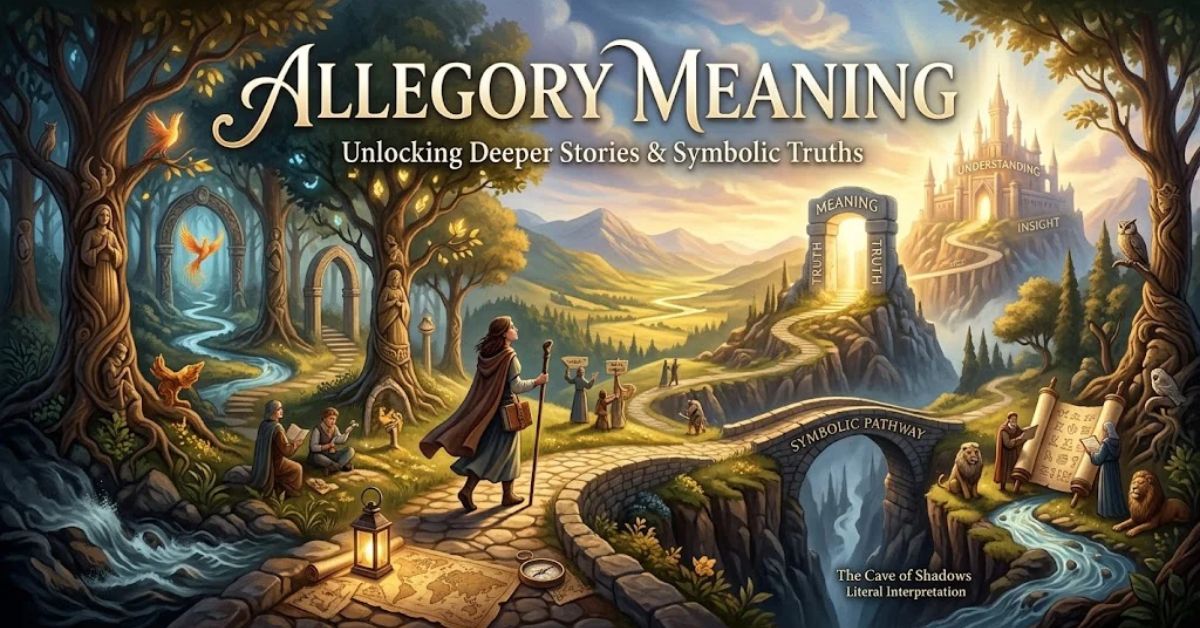
What if a simple story holds a much deeper message? A journey through a dark forest might represent life’s struggles. A locked door could stand for lost freedom. Writers often use characters, places, and events to share ideas without explaining them directly. This technique makes stories more powerful and gives readers something to think about. You can find it in famous books, poems, films, and even everyday storytelling.
Understanding allegory meaning helps you look beyond the surface of a story. You begin to notice the hidden messages behind its symbols and characters. It also becomes easier to understand how allegory differs from metaphor, symbolism, and other literary devices. In this guide, you’ll learn its definition, history, types, and famous examples. You’ll also see how writers use allegory to discuss life, society, power, and human behavior.
Definition & Core Meaning
The allegory meaning goes beyond an ordinary story or simple comparison. An allegory is a symbolic narrative that communicates a deeper meaning through characters, events, and situations. Instead of explaining an idea directly, it uses storytelling to represent abstract ideas. These ideas may involve truth, morality, freedom, power, or human nature.
In literature, allegory works as an important literary device. Writers use symbols and figurative language to express messages beneath the surface. A story may seem simple at first, but its hidden meaning reveals something much bigger.
For example, a journey through darkness might represent someone’s struggle to find truth. This layered meaning encourages readers to think beyond the words.
Core Meanings of Allegory
At its heart, allegory means expressing one idea through another. It allows writers to communicate complex messages using familiar stories and symbols. The word comes from the Greek allēgoria, meaning “speaking otherwise.”
Here are some important meanings associated with allegory:
- Hidden meaning: A story represents an idea beyond its literal events.
- Symbolic narrative: Characters and situations stand for deeper concepts.
- Extended metaphor: Symbolism continues throughout an entire story.
- Moral lesson: A narrative teaches readers about right and wrong.
- Abstract ideas: Stories represent concepts like justice, freedom, and truth.
- Multiple interpretations: Readers may understand different messages depending on context.
Unlike a simple metaphor, allegory maintains sustained symbolism across a larger narrative. That’s what makes it so powerful.
Simple Examples
Understanding allegory becomes easier when you look at everyday examples. Imagine a story about a small bird trapped inside a golden cage. Literally, it describes a bird that cannot fly freely. However, its deeper meaning might represent a person living without freedom.
Here are a few simple examples:
- A dark forest represents confusion or uncertainty.
- A broken bridge symbolizes damaged relationships.
- A long journey represents personal growth.
- A rising sun represents hope after difficult times.
- A locked door symbolizes missed opportunities.
You might hear someone say, “The movie was an allegory about freedom and control.”
They aren’t discussing freedom alone. They’re explaining how the entire story represents a bigger struggle.
Historical & Cultural Background
Allegory has a long history in human storytelling. People have used symbolic narratives to explain difficult ideas for centuries. Ancient stories often explored morality, religion, politics, and human nature through characters and events.
Greek philosophers used allegory to discuss truth, ethics, and knowledge. Religious texts also used symbolic storytelling to communicate spiritual lessons. Over time, writers and artists adopted this literary device for different purposes.
Today, allegory appears in novels, paintings, films, political commentary, and education. It helps people understand complicated subjects through familiar situations. Although storytelling methods change, the desire to communicate deeper truths remains strong.
Ancient Meanings
The history of allegory reaches back to ancient Greece. The word comes from allēgoria, which means “speaking otherwise.” Greek philosophers used symbolic explanations to discuss ideas that ordinary language couldn’t easily express.
One famous example is Plato’s Allegory of the Cave. In this philosophical narrative, prisoners watch shadows on a cave wall. They believe those shadows represent reality because they’ve never seen anything else.
However, one prisoner eventually escapes and discovers the outside world. His experience represents the journey from illusion and knowledge toward truth and understanding.
Ancient writers also used allegorical interpretations to explain mythology and religious ideas. These stories encouraged readers to question appearances and search for deeper meanings.
Cultural Interpretations
Different cultures have used allegory to preserve knowledge, share beliefs, and teach important lessons. Their storytelling traditions often reflect local history, values, and experiences.
For example:
- Western traditions: Allegory frequently explores political power, morality, freedom, and philosophy.
- Asian traditions: Some traditional stories use symbolism to communicate harmony, wisdom, and ethical behavior.
- Middle Eastern traditions: Religious and poetic storytelling often explores faith, truth, and spiritual understanding.
- African traditions: Oral storytelling can preserve ancestry, history, and community values.
- Latin traditions: Folklore and literary works often use symbolic narratives to examine identity and social struggles.
- Indigenous traditions: Many Indigenous myths connect nature, ancestry, and community teachings.
These traditions aren’t identical. Their allegories reflect different histories and cultural perspectives.
Emotional & Psychological Meaning
Allegory doesn’t only communicate intellectual ideas. It can also express emotions that people struggle to explain directly. Writers often use symbolic characters and situations to represent grief, loneliness, fear, trust, and inner conflict.
For example, a character wandering through a storm might represent someone facing emotional difficulties. The storm becomes a symbol of personal struggles rather than ordinary weather.
This symbolic distance allows readers to connect with difficult experiences without confronting them too directly. It can also encourage empathy by showing how others experience similar challenges.
In this way, allegory becomes more than a literary technique. It offers a meaningful way to examine human emotions, personal beliefs, and psychological experiences.
Identity & Self-Reflection
Allegorical stories often encourage readers to examine their identity and personal choices. Instead of directly explaining someone’s struggles, writers create characters who represent different parts of human experience.
For example, a character searching for a lost home might represent someone trying to understand their identity. Their journey becomes a symbol of self-discovery and personal growth.
These stories can help readers think about:
- Their personal values and beliefs.
- Their fears, dreams, and ambitions.
- The difference between appearance and reality.
- Their relationships with family and society.
- Their understanding of truth and morality.
An allegorical character can act like a mirror. You may recognize your own experiences in their struggles, even when the story describes a completely different world.
Healing & Mindset
Sometimes, difficult emotions feel easier to understand through stories. Allegory provides symbolic distance that allows readers to examine painful experiences indirectly. A story about rebuilding a damaged garden, for example, might represent emotional healing after a difficult period.
This approach can encourage reflection without requiring someone to explain every personal detail. It may also support empathy and emotional insight.
Allegorical storytelling can explore several experiences:
- Grief: A fading sunset may represent loss.
- Trauma processing: A character escaping darkness may represent recovery.
- Trust: A fragile bridge may symbolize rebuilding relationships.
- Mindset: A mountain climb may represent overcoming challenges.
- Healing: New flowers may symbolize hope and renewal.
However, stories aren’t a replacement for professional mental health support. Their value lies in helping people reflect on emotions and experiences.
Different Contexts & Use Cases
Allegory appears in many areas of everyday life. Although people often associate it with novels and poetry, its use extends much further. Writers, artists, teachers, and filmmakers use symbolic storytelling to communicate complicated messages.
For example, a film about animals fighting for control might actually criticize political systems. Similarly, a painting showing a broken clock could represent lost time or regret.
Common contexts include:
- Literature: Novels and short stories communicate moral or philosophical ideas.
- Religion: Symbolic narratives explain spiritual beliefs and lessons.
- Art: Visual symbols represent emotions and social issues.
- Politics: Stories criticize power and authoritarian control.
- Education: Teachers use familiar narratives to explain abstract ideas.
- Media: Films and documentaries communicate social messages.
Allegory gives creators another way to discuss sensitive subjects without stating everything directly.
Personal Life
Allegory can also help people explain personal experiences through simple stories. You don’t need to write a novel or understand complex literature to use it. Sometimes, an everyday comparison can communicate feelings more clearly than direct words.
Imagine someone describing their difficult year as a long road filled with unexpected turns. That road represents personal challenges rather than an actual journey.
Here are some conversational examples:
- “My childhood was like a garden that needed care.”
- “His journey through darkness represents his personal struggles.”
- “That story is an allegory for learning from mistakes.”
- “The broken road symbolizes all the challenges she faced.”
These expressions allow people to share experiences through symbolism. They can make personal stories more meaningful and memorable.
Social Media
Social media has made symbolic storytelling popular in modern communication. People often use allegorical ideas in social media captions, short videos, artwork, and storytelling posts. These messages allow creators to express complicated feelings through simple images or narratives.
For example, someone might post a picture of a butterfly leaving its cocoon. The image could represent personal growth, freedom, or a fresh beginning.
You might see captions such as:
- “Every storm eventually passes.”
- “The broken wings still remember how to fly.”
- “A new chapter begins after every ending.”
- “Sometimes, the darkest roads lead to light.”
Not every symbolic caption qualifies as a complete allegory. However, these examples show how allegorical storytelling can influence modern media and online expression.
Relationships
Allegory can help people express complicated relationship experiences without directly blaming someone. A symbolic story may communicate feelings about trust, loyalty, heartbreak, or emotional distance.
For example, imagine someone describing a relationship as a bridge that slowly fell apart. The bridge represents their connection, while its damage reflects broken trust.
Here are a few conversational examples:
- “Our relationship feels like a garden without water.”
- “That story represents the importance of trust.”
- “The broken mirror symbolizes how our friendship changed.”
- “Her journey represents learning to love herself again.”
These expressions encourage reflection and emotional understanding. They can also help people discuss difficult experiences more gently.
However, allegory shouldn’t replace honest communication when a relationship needs clear boundaries or direct conversations.
Professional or Modern Usage
Allegory remains useful in professional and modern communication. Writers, educators, filmmakers, and political commentators use it to explain complicated subjects. It can also help audiences understand social problems through familiar situations.
For example, a movie about animals competing for leadership might represent political power and authoritarian control. Similarly, a fictional city divided by wealth could criticize class and inequality.
Common professional uses include:
- Education: Teachers explain abstract ideas through symbolic stories.
- Literature: Authors explore ethics, morality, and human behavior.
- Politics: Writers criticize government decisions and social control.
- Film: Directors communicate messages about freedom and society.
- Advertising: Creative campaigns use symbolic images to represent ideas.
- Media: Commentators use allegory to critique systems and society.
In professional writing, allegory can make complex arguments more memorable without overwhelming readers.
Hidden, Sensitive, or Misunderstood Meanings
Allegory often carries messages that aren’t immediately obvious. Readers may notice the surface story first and recognize its deeper meaning later. This happens because characters, settings, and events represent ideas beyond their literal roles.
For example, a fictional kingdom ruled by a cruel leader might represent authoritarian control. Its citizens could symbolize people struggling against unfair systems.
However, allegory doesn’t always communicate one fixed message. Different readers may interpret the same story differently because of their experiences and cultural backgrounds.
Some allegories also address sensitive subjects. Writers may use symbolic distance to discuss religion, political power, inequality, or personal suffering. This approach allows difficult topics to receive attention without direct confrontation.
Common Misunderstandings
Allegory is sometimes confused with other literary devices. Although these concepts share similarities, they don’t always serve the same purpose. Understanding their differences helps you recognize allegorical writing more accurately.
Here are some common misunderstandings:
- Allegory is just a metaphor: A metaphor makes a comparison, while allegory usually extends symbolism across a narrative.
- Allegory only appears in literature: It also appears in art, religion, politics, and film.
- Every symbol creates an allegory: A single symbol doesn’t necessarily represent an entire symbolic narrative.
- Allegory always teaches a moral lesson: Some allegories explore political, psychological, or philosophical questions instead.
- Every allegory has one correct interpretation: Some works intentionally allow multiple interpretations.
Allegory can overlap with parables, fables, myths, and satire. However, each literary form has its own characteristics.
What People Miss
The most interesting part of allegory often lies beneath its visible story. Readers sometimes focus entirely on characters and events without considering what those elements represent.
However, allegory works through connections between literal storytelling and deeper ideas. A character might represent freedom, while an entire kingdom symbolizes social control. These connections create layered meaning throughout the narrative.
Here are a few important things people often overlook:
- Context matters: Historical and cultural backgrounds influence interpretation.
- Symbols work together: Several connected symbols can develop one central message.
- Meaning can change: Different generations may interpret the same allegory differently.
- Ambiguity is intentional: Some writers leave room for multiple interpretations.
- The message isn’t always moral: Allegories can explore power, identity, politics, and human conflict.
Once you recognize these details, you can understand stories beyond their surface events.
Comparison Section
Understanding the allegory meaning becomes easier when you compare it with similar literary terms. Allegory, metaphor, symbolism, parable, and fable all communicate ideas beyond literal words. However, each one works differently.
| Literary Term | Meaning | Key Difference |
| Allegory | A symbolic story with deeper meaning | Sustains symbolism throughout a narrative |
| Metaphor | A direct comparison between two things | Usually compares specific ideas or objects |
| Symbolism | Using symbols to represent something else | Can involve a single object or image |
| Parable | A short story that teaches a lesson | Often focuses on moral or spiritual lessons |
| Fable | A short fictional moral tale | Frequently features talking animals |
| Satire | Uses humor or irony to criticize problems | Highlights flaws in people or society |
| Myth | A traditional story explaining beliefs or origins | Often involves gods, heroes, or supernatural events |
For example, calling someone a shining star is a metaphor. However, a story about a star guiding a lost traveler could develop into an allegory.
The main difference is sustained symbolism. Allegory connects several symbolic elements to communicate a broader message.
Popular Types & Variations of Allegory
Allegory appears in different forms depending on the message a writer wants to communicate. Some stories teach moral lessons, while others examine political power, religion, society, or human emotions.
Understanding the different types of allegory helps you recognize their deeper meanings. Each variation uses characters, events, and symbols to represent particular ideas.
Here are nine popular types of allegory:
1. Moral Allegory
A moral allegory teaches readers about right and wrong through symbolic storytelling. It often explores honesty, kindness, courage, responsibility, and virtue. Instead of directly telling readers what to do, the writer creates characters who face difficult choices.
Their decisions reveal the consequences of good and bad behavior. These stories encourage readers to think about their values and actions.
Example: Imagine a story about two travelers. One shares food with strangers, while the other keeps everything for himself. Eventually, the generous traveler receives help during a difficult journey.
The story represents kindness and generosity.
You might explain it by saying, “The story is a moral allegory about helping others.”
2. Political Allegory
Political allegory uses fictional characters, events, and settings to represent political systems or real-world power struggles. Writers often use this form to criticize corruption, authoritarian control, inequality, and unfair leadership.
Instead of naming actual political figures, they communicate their ideas through symbolic narratives. This approach can make sensitive political subjects easier to discuss.
Example: Imagine a story about farm animals who remove their human owner. They establish a new government but eventually face another unfair ruler.
The story could represent political revolutions and the dangers of concentrated power.
A famous example is George Orwell’s Animal Farm. It uses farm animals to examine political power, propaganda, and authoritarian control.
You might say, “The novel is a political allegory about power and corruption.”
3. Religious Allegory
Religious allegory uses symbolic characters, events, and journeys to communicate spiritual beliefs. It often explores faith, morality, temptation, forgiveness, and the relationship between humans and divine truth.
Religious texts and spiritual traditions sometimes use symbolic narratives to explain complicated teachings. These stories encourage readers to consider the deeper meaning behind visible events.
Example: Imagine a traveler crossing a dangerous desert to reach a peaceful city. The journey represents a person’s spiritual struggle to strengthen their faith.
One famous literary example is John Bunyan’s The Pilgrim’s Progress. Its central journey represents the Christian experience of faith and salvation.
You might explain, “The story uses religious allegory to represent the journey toward spiritual understanding.”
4. Philosophical Allegory
Philosophical allegory explores abstract ideas through symbolic stories. It often examines truth, knowledge, freedom, reality, ethics, and human existence.
Writers and philosophers use this form to encourage readers to question their beliefs. Instead of providing simple answers, they present situations that challenge ordinary thinking.
Example: Plato’s Allegory of the Cave is one of the most famous examples. Prisoners watch shadows on a wall and believe those shadows represent reality. One prisoner escapes and discovers the outside world.
The story explores illusion and knowledge. It also represents the difficult journey toward truth and understanding.
You might say, “Plato’s Cave is a philosophical allegory about discovering reality beyond appearances.”
5. Psychological Allegory
Psychological allegory uses characters and situations to represent emotions, thoughts, fears, and inner conflicts. It often explores identity, trauma, loneliness, anxiety, and personal growth.
Writers use symbolic distance to discuss experiences that may feel difficult to express directly. A fictional struggle can represent a person’s internal emotional battle.
Example: Imagine a character walking through a dark forest while searching for a missing light. The forest represents confusion, while the light symbolizes hope and emotional clarity.
This story could represent someone’s struggle with self-doubt.
Psychological allegory also encourages self-reflection and empathy.
You might explain, “The story is a psychological allegory about overcoming inner conflict and finding confidence.”
6. Social Allegory
Social allegory uses symbolic storytelling to examine problems within communities and society. It often explores class and inequality, discrimination, social control, poverty, and unfair treatment.
Writers create fictional communities that reflect real social conditions. Their characters may represent different groups, social roles, or struggles.
Example: Imagine a city where wealthy citizens live behind tall walls. Everyone outside those walls works hard but receives very few opportunities.
The divided city represents social inequality and class differences.
Social allegory encourages readers to question unfair systems. It can also promote empathy and awareness of community problems.
You might say, “The film is a social allegory about inequality and the division between rich and poor.”
7. Historical Allegory
Historical allegory uses fictional characters and events to represent real historical experiences. It may explore wars, revolutions, political movements, cultural changes, or struggles for independence.
Writers often draw inspiration from actual events while creating symbolic stories. This allows them to examine history from a different perspective.
Example: Imagine a fictional kingdom where ordinary citizens rise against an unfair ruler. Their struggle represents a historical revolution against oppression.
Historical allegory can help readers understand the causes and consequences of major events. However, not every historical story qualifies as an allegory. Its characters and events must carry symbolic meaning.
You might say, “The novel is a historical allegory about revolution and the struggle for freedom.”
8. Environmental Allegory
Environmental allegory uses nature and symbolic storytelling to communicate messages about the environment. It often explores pollution, deforestation, climate damage, human responsibility, and the relationship between people and nature.
Writers may use dying forests, polluted rivers, or disappearing animals to represent environmental destruction. These images make serious issues easier to understand emotionally.
Example: Imagine a village where a beautiful green forest slowly turns into dry land. As the trees disappear, the villagers begin losing their homes and resources.
The dying forest represents environmental damage caused by human actions.
This type of allegory can encourage readers to think about conservation and sustainability.
You might say, “The story is an environmental allegory about the consequences of destroying nature.”
9. Personal Allegory
Personal allegory represents an individual’s experiences, emotions, memories, or struggles through symbolic storytelling. It often explores relationships, identity, grief, trust, ambition, and personal growth.
Unlike broader political or social allegories, this form focuses on individual experiences. Writers may use familiar objects, journeys, and natural events to communicate personal feelings.
Example: Imagine someone writing about a small plant growing through a crack in concrete. The plant represents their determination to succeed despite difficult circumstances.
Its growth symbolizes hope, resilience, and personal development.
Personal allegory can also help people express emotions that feel difficult to explain directly.
You might say, “Her story is a personal allegory about finding strength after heartbreak.”
How to Respond When Someone Asks About It
When someone asks about the allegory meaning, you don’t need to give a complicated literary explanation. A simple answer can explain the idea clearly. Your response may depend on the conversation and how much the other person wants to know.
For example, a student might ask about allegory during class. A friend might mention it while discussing a movie or novel. In either situation, you can explain that allegory uses a story to communicate a deeper message.
Here are several ways to respond:
- Keep casual explanations short and friendly.
- Use meaningful responses when discussing literature.
- Add humor when the conversation feels relaxed.
- Choose thoughtful words when discussing personal experiences.
The goal is to explain the concept without making it sound overly complicated.
Casual Responses
Casual responses work best when someone wants a quick explanation. You can describe allegory as a story that represents something deeper. There’s no need to introduce complicated literary terms unless the person asks.
For example, imagine a friend discussing a movie with talking animals. You might explain that the animals represent different types of people or political groups.
Here are some natural responses:
- “It’s basically a story with a hidden meaning.”
- “It uses characters to represent bigger ideas.”
- “It’s storytelling with a deeper message.”
- “The story means more than what happens on the surface.”
- “It’s a way of explaining ideas through symbols.”
Conversation example:
Friend: “What does allegory actually mean?”
You: “It’s a story that uses characters and events to explain something deeper.”
This answer is simple, friendly, and easy to understand.
Meaningful Responses
Sometimes, a basic definition isn’t enough. When discussing literature, philosophy, or art, you may want to explain how allegory communicates deeper ideas.
A meaningful response highlights the connection between the visible story and its symbolic message. It can also mention morality, truth, freedom, or human behavior.
Try these responses:
- “An allegory tells one story while communicating another message underneath.”
- “It uses symbolism to explain complex ideas.”
- “It’s a literary device that gives ordinary stories deeper meaning.”
- “Characters often represent real-world beliefs, struggles, or values.”
- “It helps writers discuss difficult subjects through storytelling.”
Conversation example:
Friend: “Why do people call that novel an allegory?”
You: “Because its characters represent larger ideas about society, power, and human behavior.”
These responses work well in classrooms, book discussions, and thoughtful conversations.
Fun Responses
Allegory doesn’t always require a serious explanation. Sometimes, a playful answer makes the concept easier to remember. You can use humor or simple comparisons when talking with friends.
The trick is to explain the idea without losing its meaning. A little creativity can make literary concepts feel less intimidating.
Here are some fun responses:
- “It’s a story wearing a disguise.”
- “It’s a hidden message dressed as fiction.”
- “Think of it as storytelling with secret layers.”
- “It’s a lesson hiding behind interesting characters.”
- “The story has more secrets than it first appears.”
Conversation example:
Friend: “So, what’s an allegory?”
You: “It’s basically a story with a secret identity. The characters represent bigger ideas.”
This approach works especially well during casual conversations about books, movies, and animated films.
Private Responses
Sometimes, people use allegorical stories to express personal feelings. They might discuss grief, trust, loneliness, heartbreak, or difficult experiences without sharing every detail.
In these situations, your response should feel thoughtful and respectful. Avoid pushing someone to explain the hidden meaning if they aren’t comfortable sharing.
You can respond with phrases like:
- “That story seems to represent something personal.”
- “I think there’s a deeper emotion behind those words.”
- “Sometimes stories explain feelings better than direct conversations.”
- “The symbolism makes the message feel more meaningful.”
- “You don’t have to explain everything for the message to matter.”
Conversation example:
Friend: “My story about a broken bridge represents something personal.”
You: “I understand. Sometimes symbolic stories make difficult feelings easier to express.”
A gentle response can make someone feel understood without crossing personal boundaries.
Regional & Cultural Differences
Allegory appears across different cultures and storytelling traditions. However, its symbols and messages can vary depending on history, religion, language, and social values.
Some stories focus on morality and spiritual beliefs. Others examine political power, community relationships, nature, or personal identity.
For example, a journey might symbolize spiritual growth in one story. In another, it could represent freedom or social change.
Cultural background also influences how readers interpret symbols. The same animal, color, or natural image may carry different meanings across communities.
Understanding these differences helps you appreciate allegory without assuming every culture uses symbolism in the same way.
Western Cultures
Western literary traditions have a long history of allegorical storytelling. Writers have used symbolic narratives to explore religion, politics, philosophy, morality, and human nature.
Ancient Greek philosophers helped shape allegorical interpretation. Plato’s Allegory of the Cave remains a famous example of philosophical storytelling.
Later, European writers used allegory to discuss faith, personal struggles, and political systems. John Bunyan’s The Pilgrim’s Progress presents a spiritual journey through symbolic characters and places.
Other works use allegory to examine freedom, social control, and inequality.
Common themes include:
- Good versus evil.
- Freedom and political power.
- Faith and spiritual growth.
- Truth and human knowledge.
- Morality and personal responsibility.
These traditions show how allegory can communicate complex ideas through familiar stories.
Asian Cultures
Asian storytelling traditions include many symbolic tales, philosophical narratives, religious stories, and folklore. These works often explore wisdom, harmony, duty, nature, and the relationship between individuals and communities.
However, Asia includes many distinct cultures and literary traditions. Their symbols and interpretations can differ greatly.
For example, some traditional Chinese stories use symbolic journeys to explore wisdom and personal development. Buddhist and Hindu storytelling traditions also contain narratives that communicate spiritual and moral ideas.
Common themes found in various Asian traditions include:
- Harmony between humans and nature.
- Wisdom and self-discipline.
- Respect and family responsibility.
- Spiritual growth and enlightenment.
- Balance between personal desires and social duties.
These examples show how symbolic storytelling can preserve cultural values while communicating deeper lessons.
Middle Eastern Cultures
Middle Eastern literary and storytelling traditions contain rich examples of symbolism, spiritual themes, poetry, and moral storytelling. Allegorical ideas can appear in religious texts, philosophical writings, poetry, and traditional tales.
These stories often examine faith, justice, wisdom, human responsibility, and the search for truth.
For example, Persian literary traditions include symbolic journeys and characters that represent spiritual development. The writings of Rumi often use everyday images, such as light and darkness, to communicate deeper spiritual ideas.
Common themes include:
- Faith and spiritual understanding.
- Justice and moral responsibility.
- Love and human relationships.
- Wisdom and the search for truth.
- The struggle between good and evil.
These traditions demonstrate how symbolic narratives can express ideas that ordinary language may struggle to capture.
African & Latin Cultures
African and Latin American storytelling traditions use symbolism to explore identity, history, ancestry, nature, and community values. Oral storytelling plays an important role in many African communities. Traditional tales often pass knowledge and moral lessons between generations.
For example, animal characters in African folktales may represent human behavior, cleverness, greed, or wisdom. Their actions communicate lessons about relationships and society.
Latin American literature also uses allegorical storytelling to examine political struggles, cultural identity, inequality, and historical change. Magical realism sometimes combines ordinary life with unusual events to create deeper symbolic meanings.
Important themes include:
- Ancestry and cultural identity.
- Community values and shared history.
- Freedom and social inequality.
- Nature and spiritual beliefs.
- Political change and personal struggles.
These traditions highlight the power of storytelling to preserve cultural memory and communicate meaningful ideas.
FAQs
What is the simple meaning of allegory?
Allegory is a story with a hidden message. Characters and events represent deeper ideas, such as freedom, truth, or morality.
What is an example of an allegory?
Animal Farm by George Orwell is a famous example. It uses farm animals to represent political power and control.
What is the difference between allegory and metaphor?
A metaphor compares two things directly. Allegory uses an entire story, including characters and events, to express deeper meanings.
What are the main types of allegory?
Common types include moral, political, religious, philosophical, social, and psychological allegory. Each explores deeper ideas through symbolic storytelling.
Why is understanding allegory meaning important?
Understanding allegory meaning helps you recognize hidden messages in stories. It also makes literature, films, and symbolic narratives easier to understand.
Conclusion
Understanding allegory meaning helps you look beyond the surface of a story. It shows how writers use characters, events, and symbols to share deeper ideas. These ideas may focus on truth, freedom, love, power, or human behavior. You can find allegory in books, poems, films, and religious stories. Famous examples like Animal Farm and Plato’s Allegory of the Cave make complex ideas easier to understand. Once you know what to look for, hidden messages become easier to spot.
The allegory meaning also helps you understand how stories connect with real life. It teaches you to think about the message behind each event. Remember, allegory is more than a simple symbol or comparison. It uses a whole story to express a deeper meaning. Keep these ideas in mind when reading. You may find that familiar stories have much more to say than you first imagined.
