


What happens when a company makes thousands of products but even a few have defects? Small mistakes can lead to wasted time, unhappy customers, and higher costs. That’s why businesses use a quality metric called DPMO. It stands for Defects Per Million Opportunities. It shows how often defects occur across one million chances for errors. Companies use this measure to understand process quality and spot areas that need improvement.
Understanding dpmo meaning makes it easier to see how businesses track performance and reduce mistakes. You’ll find this term in Six Sigma, manufacturing, healthcare, software testing, and customer service. Quality managers and production teams use DPMO to measure results and compare processes. It also helps them find problems and make better decisions. In simple terms, a lower DPMO usually means fewer defects and better quality.
Origin and Cultural Footprint

The dpmo meaning comes from the Six Sigma approach to quality management. Motorola developed Six Sigma in the 1980s to reduce manufacturing defects and improve process quality. Companies needed a standard way to measure mistakes across different operations. That’s where Defects Per Million Opportunities became important.
During the 1990s, General Electric (GE) helped bring Six Sigma into mainstream business practices. DPMO gradually reached industries beyond manufacturing.
Today, you’ll find this quality metric in several fields:
- Manufacturing and production management.
- Healthcare billing and customer service.
- Software testing and logistics.
- Finance and supply chain operations.
By the early 2000s, business schools and Lean Six Sigma certification programs had made DPMO familiar to more process improvement professionals. Its purpose remains simple: measure defects and support waste reduction.
Other Meanings of DPMO
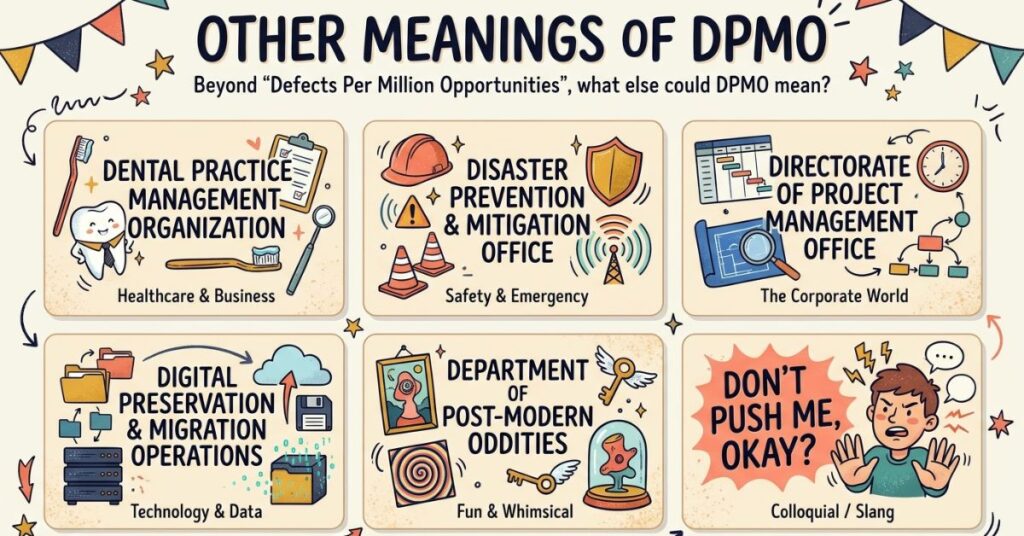
DPMO has a well-established meaning in quality management. It stands for Defects Per Million Opportunities. However, some organizations use the same letters for internal terms. These alternative meanings usually depend on company documents or departmental shorthand.
Two less common expansions sometimes appear in corporate settings:
- Defined Process Mapping Output: A possible internal term for a process mapping deliverable.
- Data Process Monitoring Office: A possible departmental name within an organization.
- Defects Per Million Orders: A common misunderstanding rather than the standard definition.
If you encounter DPMO in a workplace message, check the surrounding conversation. A quality manager will most likely mean the Six Sigma metric. An internal company wiki might use it differently.
Remember, DPMO isn’t widely recognized as a casual slang or texting abbreviation. Its meaning usually connects to a professional or technical discussion.
Why Does DPMO Have So Many Different Definitions?
Acronyms often create confusion because different departments use identical letters. DPMO is a good example of this workplace problem. Manufacturing teams, software departments, and corporate offices sometimes develop their own internal shorthand.
However, dpmo meaning usually refers to Defects Per Million Opportunities. This definition dominates Six Sigma and quality management discussions. Other expansions generally appear in specific organizations rather than across entire industries.
A few reasons explain this confusion:
- Departmental shorthand: Teams create abbreviations for internal tasks and projects.
- Acronym collisions: Different industries reuse the same four letters.
- Technical differences: Some professionals confuse DPMO with related quality metrics.
- Limited context: Short emails and messages don’t always explain the intended meaning.
For example, a production supervisor discussing defect tracking probably means the Six Sigma metric. However, an internal department document might use DPMO for something else. Always consider the surrounding topic before interpreting an unfamiliar abbreviation.
Does DPMO Mean the Same Thing Outside the US?
Yes, DPMO generally keeps the same meaning across countries. It stands for Defects Per Million Opportunities in international Six Sigma and quality management practices. Manufacturing companies, healthcare organizations, and service industries use it worldwide.
The terminology remains familiar across the US, Europe, and Asia. However, some organizations prefer related measurements such as DPM (Defects Per Million).
Here are a few important points:
- International manufacturers use DPMO to compare process quality.
- Lean Six Sigma practitioners apply it during improvement projects.
- Quality managers use it in global performance reports.
- Some teams prefer DPM for simpler defect tracking.
For example, a production team in Germany might report DPMO during a quality review. A similar team in Pakistan could use the same metric.
The calculation and basic purpose remain consistent. However, companies may define opportunities for defects differently depending on their products and processes.
Who Uses It Most?
DPMO mainly belongs to professional environments where teams measure quality and reduce errors. You won’t usually see it in everyday texting. However, it plays an important role in manufacturing, customer service, and business operations.
Different professionals use this quality metric for specific reasons.
| Professional group | How they use DPMO |
| Six Sigma practitioners | Measure process quality and improvement |
| Quality managers | Monitor defect rates and quality targets |
| Manufacturing teams | Track production line defects |
| Call center managers | Measure service and billing errors |
| Production supervisors | Review daily manufacturing performance |
| Engineering leads | Monitor failed transactions and technical issues |
| Regional directors | Evaluate team performance across locations |
For example, a quality manager might discuss rising DPMO during weekly quality huddles. A production supervisor may then investigate misaligned parts or failed weld points.
Similarly, call center managers can use DPMO to review errors across customer interactions. These discussions help teams identify problems instead of simply blaming individual employees.
Real Conversation Examples Using DPMO

DPMO often appears in workplace messages, shift reports, and performance review emails. People usually mention it when discussing defects, quality targets, or process improvement.
Here are some realistic examples showing how professionals use it.
Example 1: Manufacturing team
- Manager: Our DPMO increased to 4,200 this week. What changed?
- Supervisor: We introduced a new operator on Tuesday. The calibration process may need attention.
Example 2: Call center performance
- Regional director: Our billing error DPMO dropped below 3,000 this quarter. Great work!
- Team lead: Thanks! The updated script helped us catch more mistakes.
Example 3: Software testing
- Engineering lead: Did the platform migration affect our DPMO?
- Developer: The failed transaction rate stayed stable after testing.
Example 4: Quality improvement meeting
- Quality manager: Can we reduce DPMO before the next review?
- Production supervisor: We’ll inspect the sensors and recalibrate the assembly line.
These conversations show that DPMO works as professional workplace jargon. It communicates quality performance without lengthy explanations.
Usage of DPMO in Different Contexts
DPMO applies to different industries because almost every process has opportunities for mistakes. The exact defects may change, but the basic measurement stays the same.
Here’s how different sectors use it.
Manufacturing: Production teams track physical problems such as misaligned parts, damaged components, and failed weld points. They use DPMO to evaluate assembly line performance.
Software and IT: Engineering teams monitor failed transactions, testing errors, and system problems. Some projects also discuss bugs per million lines of code, although this isn’t automatically the same as standard DPMO.
Healthcare billing: Organizations monitor billing errors and processing mistakes. DPMO helps quality teams review recurring problems.
Call centers: Managers measure errors across customer interactions and service checkpoints.
Logistics and supply chain: Teams track packaging mistakes, shipment errors, and operational failures.
For example, a software team might compare DPMO before and after a platform migration. A manufacturing team may review its numbers after sensor recalibration.
How Professionals Talk About DPMO Today
Modern workplaces rely heavily on digital tools to monitor process quality. Instead of checking every spreadsheet manually, professionals often use dashboards and automated reporting.
Six Sigma software, ERP systems, and call center platforms help teams collect performance data. Quality managers can review defect tracking results without waiting for lengthy reports.
DPMO also appears in several workplace activities:
- Shift reports showing daily production performance.
- Weekly quality huddles discussing defect reduction.
- Stand-up meetings reviewing process improvement goals.
- Scorecards comparing performance across departments.
- Internal company wikis explaining technical acronyms.
Some organizations also treat DPMO as a shared team goal. They display performance numbers on shared screens and encourage employees to reduce defects. This approach can introduce gamification into everyday operations.
For example, a manufacturing team might celebrate a lower DPMO after successful recalibration. Instead of treating quality as a management responsibility, everyone contributes to improvement.
Does DPMO Mean Defects Per Million Orders?
No. DPMO does not officially stand for Defects Per Million Orders. Its correct expansion is Defects Per Million Opportunities. This distinction matters because opportunities and orders don’t represent the same thing.
An order can contain several opportunities for defects. For example, one shipment might have separate checkpoints for packaging, labeling, product condition, and documentation.
DPMO considers these individual opportunities rather than counting each order as one opportunity.
Consider this simple example:
- 1,000 orders processed.
- 5 potential defect opportunities per order.
- 5,000 total opportunities.
- 25 defects identified.
The DPMO calculation becomes:
DPMO=255,0001,000,000
Result: 5,000 DPMO.
This explains why order volume alone cannot determine DPMO. Quality managers must identify all relevant checkpoints before calculating the defect rate.
So, whenever you see someone use Defects Per Million Orders, remember that it’s a common mix-up. The standard Six Sigma measurement always refers to opportunities for defects.
Meaning Across DPMO Reporting Platforms
The dpmo meaning stays consistent across most professional reporting platforms. It stands for Defects Per Million Opportunities and helps businesses measure process quality. However, different platforms display and organize this metric according to their needs.
You’ll commonly find DPMO in these systems:
| Platform | How DPMO Is Used |
| Six Sigma software | Tracks defects during improvement projects |
| ERP systems | Monitors manufacturing and supply chain quality |
| Call center platforms | Measures customer service errors |
| Quality software | Records defects and process performance |
| Internal company wikis | Explains company-specific terminology |
For example, a quality manager might check a dashboard before a weekly meeting. Automated reporting makes it easier to compare current results with previous periods. Some smaller teams still prefer spreadsheet tracking.
Although the tools differ, DPMO gives professionals a shared way to discuss defects and improvement goals.
Common Confusions
DPMO often gets confused with other quality management terms. These abbreviations sound similar because they all relate to defects, production performance, or process quality. However, each one measures something slightly different.
Here are some common misunderstandings:
- DPM: Defects Per Million. It measures defects per million units rather than opportunities.
- PPM: Parts Per Million. It measures the concentration of a substance or the number of defective parts per million.
- Sigma Level: Shows how well a process performs against the Six Sigma quality standard.
- FPY: First Pass Yield. It measures products or services completed correctly without rework.
- COPQ: Cost of Poor Quality. It covers expenses caused by errors and quality failures.
- RCA: Root Cause Analysis. It helps teams identify why defects happen.
For example, a quality manager might use DPMO to track defects and RCA to investigate their root cause.
Understanding these differences helps you avoid mistakes during process improvement meetings and performance reviews.
Related Slang Terms
DPMO isn’t a widely recognized texting abbreviation or internet slang term. Its established meaning belongs to Six Sigma and professional quality management. Still, several related acronyms appear in workplace conversations and technical discussions.
Here are some useful terms to recognize:
- DPM: Defects Per Million.
- PPM: Parts Per Million.
- FPY: First Pass Yield.
- KPI: Key Performance Indicator.
- RCA: Root Cause Analysis.
- COPQ: Cost of Poor Quality.
- DPU: Defects Per Unit.
These abbreviations often appear in manufacturing reports, business messages, and quality dashboards.
For example:
- Manager: What’s our current DPMO?
- Team lead: It’s lower than last month’s KPI target.
- Manager: Great. Did the RCA identify the main problem?
You might also encounter these terms on LinkedIn or professional social media posts. However, DPMO itself isn’t common casual slang like LOL, BRB, or TBH.
How to Reply When Someone Mentions DPMO
Your response depends on the situation and the person’s message. If a colleague mentions DPMO, they probably want to discuss process quality, defect tracking, or performance results.
You don’t need a complicated reply. A short question or acknowledgment can keep the conversation productive.
When DPMO increases:
- Colleague: Our DPMO increased this month.
- You: Do we know what caused the increase?
When DPMO decreases:
- Manager: We reduced DPMO by 15% this quarter.
- You: That’s great! Which improvement made the biggest difference?
When someone shares a report:
- Team lead: I’ve added the latest DPMO figures to the dashboard.
- You: Thanks! I’ll review the numbers before our meeting.
When you don’t understand the abbreviation:
- Colleague: We need to discuss DPMO during tomorrow’s meeting.
- You: Could you explain what DPMO means in this report?
These responses work well in professional chats, emails, and stand-up meetings. They show interest without making the conversation unnecessarily complicated.
When Did DPMO Go Mainstream?
DPMO gained wider recognition through the growth of Six Sigma and modern quality management. Motorola introduced the Six Sigma approach during the 1980s to improve manufacturing quality and reduce defects.
During the 1990s, General Electric (GE) helped popularize Six Sigma across major business operations. As more companies adopted this approach, DPMO became an important quality metric beyond factory floors.
Its growth continued during the following decades:
- 1980s: Motorola developed Six Sigma to improve manufacturing processes.
- 1990s: General Electric expanded Six Sigma adoption across industries.
- Early 2000s: DPMO spread into healthcare, finance, logistics, and customer service.
- 2026: Companies continue using DPMO in Lean Six Sigma projects, quality software, and automated reporting.
Business schools and Lean Six Sigma certification programs also helped professionals understand this measurement.
Today, Six Sigma practitioners use DPMO to compare defect rates, identify weaknesses, and support process improvement. It has become familiar workplace terminology rather than everyday texting slang.
Conclusion
DPMO helps businesses understand how often mistakes happen during a process. It stands for Defects Per Million Opportunities. Knowing the dpmo meaning makes it easier to understand quality reports and performance results. Companies use DPMO to track defects and find areas that need improvement. You may see it in manufacturing, healthcare, software testing, and customer service. A lower DPMO usually points to better process quality.
Understanding dpmo meaning also helps you follow workplace discussions about Six Sigma. Quality managers and production teams use this metric to reduce errors and improve results. Remember that DPMO is not common texting slang. Its main use relates to quality management and process improvement. When you see DPMO in a report or conversation, consider the context. This simple step helps you understand the term correctly.
FAQs
What does DPMO mean in slang?
DPMO isn’t common slang. It usually means Defects Per Million Opportunities in Six Sigma and quality management.
What is DPMO in slang?
DPMO has no widely recognized slang meaning. Its standard meaning relates to measuring defects and process quality.
Is DPMO used on social media?
DPMO may appear in professional posts about quality management. It isn’t a common texting abbreviation or social media slang.
What does DPMO stand for?
DPMO stands for Defects Per Million Opportunities. It measures how often defects occur across one million opportunities.
What does DPMO stand for in texting?
In texting, DPMO usually retains its technical meaning. Understanding dpmo meaning helps you avoid confusing it with casual internet slang.
