

Ever received a text that starts with ICL and left you wondering what it means? You’re not alone. Internet slang is full of short forms that can leave you scratching your head. ICL stands for I Can’t Lie, and people use it to share honest thoughts, express genuine feelings, or make a statement sound more real. You might spot it in WhatsApp chats, Snapchat messages, Instagram comments, or TikTok posts. But what makes this little abbreviation so useful in everyday conversations?
ICL can add honesty, humor, or even a little attitude to a message. Someone might use it before giving a compliment, sharing an unpopular opinion, or admitting something personal. The meaning can also depend on the conversation and the person’s tone. This guide explains what does icl mean in text, how people use it, where it comes from, and how to respond naturally. You’ll also find clear examples and similar slang terms.
Meaning & Definition
ICL stands for I Can’t Lie in modern internet slang. People use this texting abbreviation to express honesty or share a genuine opinion. It adds a personal touch to casual conversations and online messages.
When someone writes ICL, they usually want you to know they’re speaking truthfully. The phrase can introduce a compliment, confession, criticism, or personal thought.
For example, someone might text, ICL, that movie was amazing. They’re simply emphasizing their honest opinion.
You may encounter this abbreviation in:
- WhatsApp messages and Snapchat chats.
- Instagram DMs and TikTok comments.
- Gaming chats and online communities.
- Social media captions and casual conversations.
ICL is an informal expression. It helps people communicate sincerity without typing a complete sentence.
What Does ICL Mean in Text?
If you’re wondering what does icl mean in text, the answer is simple: ICL means I Can’t Lie. It’s a short form people use before sharing something honest or expressing their real feelings.
Think of it as another way to say, To be honest. However, ICL often sounds more relaxed and conversational.
People commonly use it to add emphasis to their statements. It can also make personal opinions sound more direct.
Here are some common examples:
- ICL, I love this song.
- ICL, that’s actually true.
- ICL, you’re looking great today.
- ICL, I didn’t expect that ending.
For example:
Friend 1: Did you enjoy the concert?
Friend 2: ICL, it was better than I expected!
In this conversation, ICL emphasizes the speaker’s genuine feelings. It doesn’t introduce a separate meaning or complicated message.
Background / Origin
Like many texting abbreviations, ICL developed from the need for faster digital communication. Instead of typing the complete phrase I Can’t Lie, users shortened it to three letters.
Its popularity connects with modern internet slang and urban internet culture. Rap culture and English-speaking online communities also helped popularize similar expressions of honesty and emphasis.
As messaging apps and social media platforms grew, shorter expressions became common among younger users. People started using ICL in everyday conversations, comments, and online discussions.
You may encounter it across different digital spaces, including:
- Twitter (X) posts and replies.
- TikTok videos and comment sections.
- Instagram captions and direct messages.
- Snapchat conversations and WhatsApp groups.
- Gaming chats and online communities.
Today, ICL remains a casual expression of honesty. Its exact popularity can vary across communities and platforms.
Usage in Different Contexts
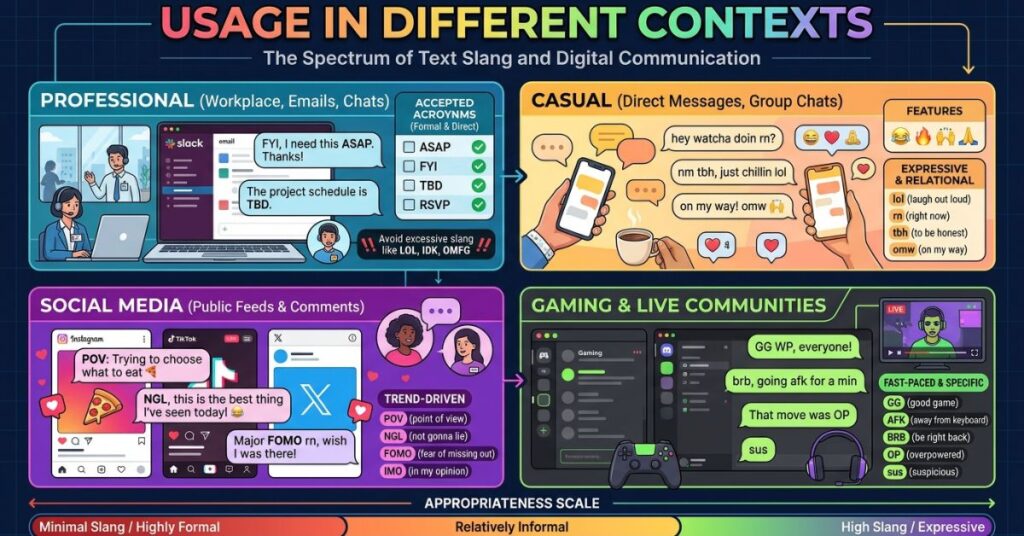
ICL can communicate different feelings depending on the conversation. Although its basic meaning stays the same, the speaker’s tone changes how you understand it.
Someone might use it to compliment a friend. Another person might introduce criticism or admit something embarrassing.
Here are some common situations where people use ICL:
- Honesty: Sharing a genuine thought without hiding anything.
- Emphasis: Making an opinion sound stronger.
- Agreement: Supporting something another person said.
- Confession: Admitting a personal feeling or mistake.
- Criticism: Introducing an honest but uncomfortable opinion.
- Humor: Making a playful comment during friendly conversations.
For example:
Friend 1: Do you like my new haircut?
Friend 2: ICL, it looks really good!
Here, ICL makes the compliment sound more personal and sincere.
General Usage
In everyday texting, ICL usually appears before a statement. It tells the reader that an honest opinion or truthful statement is coming.
People often use it when discussing music, movies, relationships, fashion, food, and everyday experiences.
For example:
Person 1: What do you think about this restaurant?
Person 2: ICL, their pizza is amazing!
You can also place ICL after a statement for extra emphasis. However, its position depends on the speaker’s writing style.
Common examples include:
- ICL, you’re absolutely right.
- That movie was boring, ICL.
- ICL, I miss those old days.
- ICL, this game is getting difficult.
ICL also works as a quick reaction in online conversations. It adds personality and emotional tone without making messages longer.
Formal vs Informal Use
ICL belongs to informal communication, not professional language. You can use it comfortably with friends, relatives, and people who understand internet slang.
However, avoid this texting abbreviation in formal situations. It may sound too casual in business emails, workplace discussions, and academic writing.
Consider these alternatives when you need a more professional tone:
| Informal expression | Formal alternative |
| ICL, you’re right. | I agree with your point. |
| ICL, this works well. | Honestly, this works well. |
| ICL, I made a mistake. | I acknowledge my mistake. |
| ICL, that’s impressive. | I genuinely find that impressive. |
For example:
Casual message: ICL, your presentation was amazing!
Professional message: I genuinely appreciate the quality of your presentation.
The meaning stays similar, but the tone changes. Choose your words based on the audience and situation.
ICL Meaning on Social Media Platforms
ICL appears across several social media platforms and messaging apps. People use it to share honest opinions, react to posts, and express genuine feelings.
Its basic meaning remains I Can’t Lie. However, the conversation and platform can influence how people interpret its emotional tone.
Here’s how you might encounter ICL on different platforms:
- WhatsApp: Friends use ICL in private chats and group conversations to share honest thoughts.
- Snapchat: Users add ICL to quick messages when expressing personal opinions or feelings.
- Instagram: It appears in DMs, comments, and captions to emphasize compliments or reactions.
- TikTok: People use ICL in video comments and discussions to express honest reactions.
- Twitter (X): Users include ICL in posts and replies when sharing direct opinions.
- Gaming chats: Players use it to express honest reactions about matches, teammates, or game performance.
Example conversation:
Friend 1: Did you like my latest Instagram post?
Friend 2: ICL, it’s one of your best pictures!
On dating apps, someone might also use ICL to express genuine feelings or share an honest opinion. The abbreviation helps keep conversations relaxed and natural.
Other Meanings in Different Fields
Although ICL commonly means I Can’t Lie in texting, the abbreviation can have multiple meanings in other contexts.
Not every use of ICL represents internet slang. Its meaning depends on the subject, industry, and surrounding conversation.
Here are some important distinctions:
- Medical meaning: ICL can refer to an Implantable Collamer Lens. Eye specialists use this term when discussing certain vision correction procedures.
- Physics meaning: ICL doesn’t have one widely recognized universal meaning in physics. A specific document or technical discussion may define its own abbreviation.
- Technology usage: ICL may appear as an abbreviation for different technical terms, depending on the software or industry.
- Context-based slang: In casual messages, ICL generally means I Can’t Lie.
For example:
Friend 1: ICL, this laptop is surprisingly fast.
Friend 2: I agree! It handles everything smoothly.
Here, ICL clearly expresses an honest opinion. However, a medical document might use the same letters for an entirely different concept.
Always check the surrounding context before deciding what an abbreviation means.
Examples of ICL Meaning in Text in Sentences
Sometimes, the easiest way to understand internet slang is through real conversation examples. ICL usually introduces an honest thought, personal opinion, or emotional reaction.
Here are some ICL examples in sentences that show how people use it naturally.
1. Sharing an honest opinion
ICL, I love this song. It has been playing in my head all day.
2. Agreeing with someone
ICL, that’s actually true. You explained the situation perfectly.
3. Giving a compliment
ICL, you look amazing in that outfit.
4. Talking about food
ICL, this burger tastes better than the expensive one.
5. Discussing relationships
ICL, I still think about our old memories sometimes.
6. Reacting to a movie
ICL, that ending completely surprised me.
7. Gaming conversations
ICL, your performance in that match was incredible.
8. Expressing disappointment
ICL, I expected something much better from that movie.
9. Talking about friendship
ICL, you’re one of the most supportive friends I’ve ever had.
10. Sharing excitement
ICL, I can’t wait for the weekend!
These examples show how ICL works across different situations. You can use it for compliments, honest criticism, quick reactions, and emotional conversations.
Common Misconceptions
Internet slang can sometimes confuse people because abbreviations don’t always have obvious meanings. ICL is no exception.
Although its main texting meaning is straightforward, several common misconceptions can lead to misunderstandings.
Here are a few things worth knowing:
- ICL is not formal language: Some people assume it’s suitable for professional communication. However, it’s mainly used in casual conversations.
- ICL doesn’t always express happiness: It can introduce positive opinions, criticism, disappointment, or serious feelings.
- ICL isn’t exactly the same as TBH: Both express honesty, but their conversational tone and usage can differ.
- ICL doesn’t have one meaning everywhere: Medical and technology discussions may use the abbreviation differently.
- ICL doesn’t guarantee honesty: Someone can write ICL before a statement without necessarily telling the truth.
- ICL isn’t limited to one platform: You can encounter it on messaging apps, social media platforms, and gaming chats.
For example:
Person 1: ICL, I didn’t enjoy that party.
Person 2: Really? I thought you had fun!
Here, ICL introduces an honest opinion rather than a positive reaction.
Understanding the context helps you avoid these common misunderstandings.
Similar Terms & Alternatives
ICL means I Can’t Lie, but it’s not the only expression people use to share honest thoughts. Several internet slang terms have similar meanings. However, each one carries a slightly different tone.
Here are some common alternatives you might see in text messages:
- TBH (To Be Honest): Used to introduce a genuine opinion or personal feeling.
- FR (For Real): Expresses agreement, seriousness, or strong emphasis.
- No Cap: Means someone isn’t lying or exaggerating.
- Honestly: A simple way to introduce a truthful statement.
- To Be Honest: A complete phrase used to share an open opinion.
- Facts: Shows agreement with something someone said.
- True That: Expresses agreement or confirms someone’s point.
Conversation example:
Friend 1: This song deserves more attention.
Friend 2: FR! ICL, it’s seriously amazing.
Although these expressions overlap, ICL specifically emphasizes honesty. Choose the alternative that best matches your message and emotional tone.
How to Respond to ICL Meaning in Text When Someone Uses It
Knowing how to respond to ICL makes online conversations easier. When someone uses this abbreviation, they’re usually sharing an honest opinion or expressing genuine feelings.
Your reply should match their message and the relationship you share. You don’t need to use another abbreviation every time.
Here are some natural responses:
- Facts 🔥: Use this when you strongly agree with someone’s opinion.
- I agree with you 👍: A friendly response that clearly shows agreement.
- True that!: Use it when someone says something you genuinely believe.
- I feel the same: A good response when someone shares personal feelings.
- Really? Tell me more: Use this when you want to continue the conversation.
- Thanks for being honest: A suitable reply when someone shares something personal.
Conversation examples:
Example 1:
Friend 1: ICL, that movie was incredible.
Friend 2: Facts 🔥 The ending was amazing!
Example 2:
Friend 1: ICL, you’ve always been a great friend.
Friend 2: I appreciate that. I feel the same!
Example 3:
Friend 1: ICL, I don’t really like this design.
Friend 2: Fair enough! What would you change?
The best response depends on the situation. Sometimes a simple agreement works perfectly. Other times, asking a follow-up question keeps the conversation going.
Difference Between ICL Meaning in Text and Similar Terms
ICL, TBH, FR, and No Cap all appear in casual digital communication. However, they don’t express exactly the same idea.
Understanding their differences helps you choose the right expression. It also makes confusing text messages easier to understand.
Here’s a quick comparison:
| Slang term | Full meaning | Common use |
| ICL | I Can’t Lie | Introducing an honest opinion |
| TBH | To Be Honest | Sharing a genuine thought |
| FR | For Real | Showing agreement or emphasis |
| No Cap | No Lie | Emphasizing truthfulness |
| Facts | That’s true | Agreeing with someone’s statement |
| Honestly | Honestly | Introducing a sincere opinion |
Let’s look at a conversation:
Friend 1: This restaurant has the best burgers.
Friend 2: ICL, they’re amazing!
Friend 3: FR, I completely agree.
Friend 4: No Cap, I’ve never tasted better burgers.
Notice how everyone expresses a similar opinion differently.
The main difference is emphasis. ICL introduces an honest statement, while TBH often sounds more neutral. FR highlights agreement or seriousness. No Cap stresses that someone isn’t lying or exaggerating.
Although these expressions sometimes overlap, they’re not always interchangeable. Understanding their tone helps you use them naturally in friendly conversations.
Relevance in Online Conversations & Dating Apps
ICL has become a useful part of casual digital communication. People use it to express honest thoughts without typing long explanations.
You might see it in private messages, social media comments, captions, and everyday online conversations. It adds personality and emotional tone to otherwise simple messages.
On dating apps, ICL can make conversations feel more personal. Someone might use it to share a genuine compliment, express attraction, or discuss their feelings.
For example:
Person 1: What was your first impression of me?
Person 2: ICL, you seemed really interesting and easy to talk to.
ICL can also introduce playful flirting or an honest opinion about a relationship.
Other common situations include:
- Flirting: ICL, your smile is really cute.
- Compliments: ICL, I love your sense of humor.
- Honest feelings: ICL, I enjoy talking to you.
- Friendly chats: ICL, we should hang out again.
- Serious conversations: ICL, I want to be honest about something.
However, remember that ICL doesn’t automatically make a statement truthful. It simply signals that the sender wants to sound honest.
If you’re wondering what does icl mean in text during a dating conversation, the usual meaning remains I Can’t Lie. Pay attention to the surrounding message to understand whether the person sounds romantic, playful, serious, or critical.
Frequently Asked Questions
1. What does ICL mean in text?
ICL means I Can’t Lie. People use it to share honest thoughts, real feelings, or personal opinions in casual conversations.
2. What does ICL mean on Snapchat?
On Snapchat, ICL means I Can’t Lie. People use it in snaps and chats to express honest opinions or reactions.
3. Is ICL rude to use in a text?
No, ICL isn’t usually rude. However, it can sound blunt when someone uses it before criticism or an uncomfortable opinion.
4. What is the difference between ICL and TBH?
Both express honesty. ICL means I Can’t Lie, while TBH means To Be Honest. People use them in similar ways.
5. How should I respond when someone says ICL?
Your response depends on the message. You can say Facts, True that, or I agree with you to show agreement.
Conclusion
Now you know what does icl mean in text. ICL stands for I Can’t Lie. People use it to share honest thoughts, feelings, and opinions. You may see it in WhatsApp chats, Snapchat messages, Instagram comments, and TikTok posts. It often adds emphasis. It can introduce a compliment, joke, or serious opinion. This short form keeps messages quick. The tone depends on the conversation, so read the full message before judging its meaning.
When someone uses ICL, reply naturally. Try saying Facts, True that, or I agree with you. You can use ICL with friends, but avoid it in formal emails or schoolwork. If you wondered what does icl mean in text, remember its simple meaning: I Can’t Lie. Knowing what does icl mean in text makes online conversations easier. Keep this meaning in mind when you see ICL again.
